Freshly Printed - allow 10 days lead
Couldn't load pickup availability
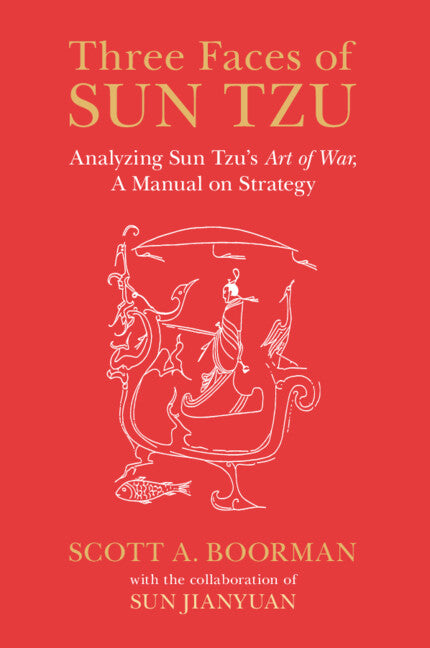
Three Faces of Sun Tzu
Analyzing Sun Tzu's Art of War, A Manual on Strategy
Thoroughly explains and analyzes Sun Tzu's thinking, drawing on Chinese language, history, archaeology, strategic analysis, and computational perspectives.
Scott Boorman (Author)
9781108456982, Cambridge University Press
Paperback / softback, published 15 February 2024
558 pages
22.7 x 15.2 x 3.6 cm, 0.91 kg
'This is a book at once timeless and topical. It reveals the enduring value (as well as limitations) of Sun Tzu's Art of War for contemporary scholarship, large corporations and government agencies. The Art of War's resonance across such a broad array of domains stems from its very nature. But to show that is no mean feat. Prof. Boorman's signal achievement with his book is to deepen our understanding of this canonical text and in so doing offer compelling heuristics for dealing purposefully with some of our world's most complex problems.' Gagandeep S. Sood, Associate Professor, Department of International History, London School of Economics
Sun Tzu's Art of War is widely regarded as the most influential military & strategic classic of all time. Through 'reverse engineering' of the text structured around 14 Sun Tzu 'themes,' this rigorous analysis furnishes a thorough picture of what the text actually says, drawing on Chinese-language analyses, historical, philological, & archaeological sources, traditional commentaries, computational ideas, and strategic & logistics perspectives. Building on this anchoring, the book provides a unique roadmap of Sun Tzu's military and intelligence insights and their applications to strategic competitions in many times and places worldwide, from Warring States China to contemporary US/China strategic competition and other 21st century competitions involving cyber warfare, computing, other hi-tech conflict, espionage, and more. Simultaneously, the analysis offers a window into Sun Tzu's limitations and blind spots relevant to managing 21st century strategic competitions with Sun-Tzu-inspired adversaries or rivals.
Introduction
1. Background: historical and textual
Preliminaries
2. Strategist should be calculating
strategist should be cheap
3. Strategist should find advantage
4. Strategist should enact stratagems & formlessness
5. Strategist should make a situation's natural dynamics work for her
6. Strategist should have an accurate grasp of the significant information
7. Strategist should manage the interfaces
Conclusion: demystifying Sun Tzu and future directions. Indices.
Subject Areas: International relations [JPS]