Freshly Printed - allow 8 days lead
Couldn't load pickup availability
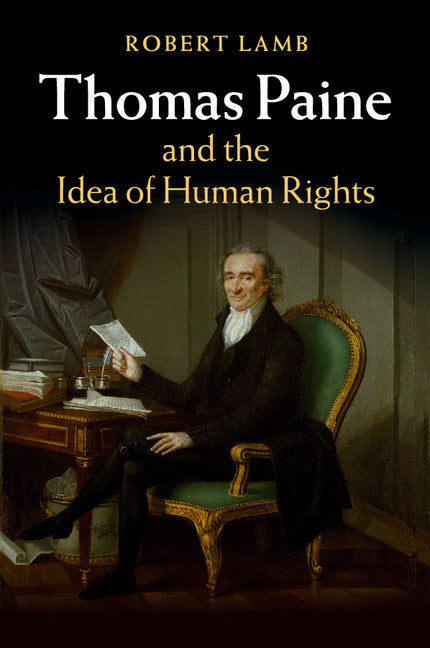
Thomas Paine and the Idea of Human Rights
An introduction to and analytical reconstruction of Thomas Paine's political philosophy and his account of human rights.
Robert Lamb (Author)
9781107514256, Cambridge University Press
Paperback / softback, published 31 August 2017
229 pages
23 x 15.2 x 1.2 cm, 0.35 kg
'In his outstanding study of Paine's reflections on moral, political, economic, international, and religious matters, Robert Lamb sets out to demonstrate both the continued relevance and the philosophical coherence of this underrated eighteenth-century thinker.' Clement Fatovic, The Review of Politics
Thomas Paine is a legendary Anglo-American political icon: a passionate, plain-speaking, relentlessly controversial, revolutionary campaigner, whose writings captured the zeitgeist of the two most significant political events of the eighteenth century, the American and French Revolutions. Though widely acknowledged by historians as one of the most important and influential pamphleteers, rhetoricians, polemicists and political actors of his age, the philosophical content of his writing has nevertheless been almost entirely ignored. This book takes Paine's political philosophy seriously. It explores his views concerning a number of perennial issues in modern political thought including the grounds for, and limits to, political obligation; the nature of representative democracy; the justification for private property ownership; international relations; and the relationship between secular liberalism and religion. It shows that Paine offers a historically and philosophically distinct account of liberalism and a theory of human rights that is a progenitor of our own.
Introduction
1. Paine as political philosopher: interpretation and understanding
2. Political obligation, human rights and the moral universe
3. Rights of democratic inclusion and the virtues of citizenship
4. Private property, the natural inheritance and rights to welfare
5. Cosmopolitanism and the rights of nations
6. Religion, creation and liberalism
Conclusion.
Subject Areas: Political science & theory [JPA], History of ideas [JFCX], Social & political philosophy [HPS]