Freshly Printed - allow 10 days lead
Couldn't load pickup availability
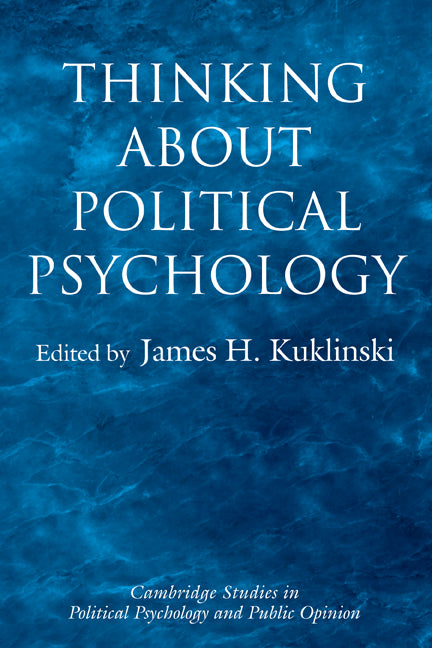
Thinking about Political Psychology
A discussion and debate of the major issues facing the field of political psychology, first published in 2002.
James H. Kuklinski (Edited by)
9780521593779, Cambridge University Press
Hardback, published 4 March 2002
368 pages, 16 b/w illus. 15 tables
23.6 x 16.1 x 2.8 cm, 0.728 kg
'Thinking about Political Psychology breaks new ground by assessing the challenges and debates within the current practice of political psychology' Acta Politica
In this 2002 volume, political psychologists take a hard look at political psychology. They pose and then address, the kinds of tough questions that those outside the field would be inclined to ask and those inside should be able to answer satisfactorily. Not everyone will agree with the answers the authors provide and in some cases, the best an author can do is offer well-grounded speculations. Nonetheless, the chapters raise questions that will lead to an improved political psychology and will generate further discussion and research in the field. The individual chapters are organised around four themes. Part I tries to define political psychology and provides an overview of the field. Part II raises questions about theory and empirical methods in political psychology. Part III contains arguments ranging from the position that the field is too heavily psychological to the view that it is not psychological enough. Part IV considers how political psychologists might best connect individual-level mental processes to aggregate outcomes.
Introduction James H. Kuklinski
Part I. Defining Political Psychology: 1. The contours of political psychology: situating research on political information processing John L. Sullivan, Wendy M. Rahn and Thomas Rudolph
Part II. Theory and Research: 2. Who can persuade whom? Implications from the nexus of psychology and rational choice theory Arthur Lupia
3. Expanding the envelope: citizenship, contextual methodologies, and comparative political psychology Pamela Johnston Conover and Donald D. Searing
4. The challenges of political psychology: lessons to be learned from research on attitude perception Jon A. Krosnick
Part III. The Psychology-Political Nexus: 5. Political psychology and political science John L. Sullivan, Wendy M. Rahn and Thomas Rudolph
6. Is political psychology sufficiently psychological? Distinguishing political psychology from psychological political science Jon A. Krosnick
7. Political psychology, political behavior, and politics: questions of aggregation, causal distance, and taste Robert C. Luskin
Part IV. Political Psychology and Aggregate Opinion: 8. The micro foundations of mood James A. Stimson
9. From denial to extenuation (and finally beyond): political sophistication and citizen performance Robert C. Luskin
10. Political psychology and the micro-macro gap in politics.