Freshly Printed - allow 10 days lead
Couldn't load pickup availability
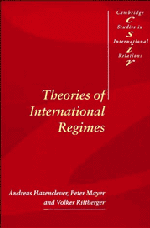
Theories of International Regimes
The authors examine three different theoretical approaches to international regimes: realism, neoliberalism and cognitivism.
Andreas Hasenclever (Author), Peter Mayer (Author), Volker Rittberger (Author)
9780521591454, Cambridge University Press
Hardback, published 2 October 1997
264 pages, 2 tables
23.6 x 15.8 x 2.3 cm, 0.541 kg
'The strengths of the book are its clarity, accessibility and ordered structure and the breadth of literature which it covers in a convincing manner. This is an important book within the field, reflecting on its place in the discipline of international relations and searching for an identity, and is all the more interesitng for it.' Peter Newell, International Affairs
International regimes have been a major focus of research in international relations for over a decade. Three schools of thought have shaped the discussion: realism, which treats power relations as its key variable; neoliberalism, which bases its analysis on constellations of interests; and cognitivism, which emphasizes knowledge dynamics, communication, and identities. Each school articulates distinct views on the origins, robustness, and consequences of international regimes. This book examines each of these contributions to the debate, taking stock of, and seeking to advance, one of the most dynamic research agendas in contemporary international relations. While the differences between realist, neoliberal and cognitivist arguments about regimes are acknowledged and explored, the authors argue that there is substantial scope for progress toward an inter-paradigmatic synthesis.
List of figures and tables
Acknowledgments
1. Introduction: three perspectives on international regimes
2. Conceptual issues: defining international regimes
3. Interest-based theories: political market failure, situation and problem structures, and institutional bargaining
4. Power-based theories: hegemony, distributional conflict and relative gains
5. Knowledge-based theories: ideas, arguments and social identities
6. Conclusion: prospects for synthesis
References
Index.
Subject Areas: International relations [JPS]