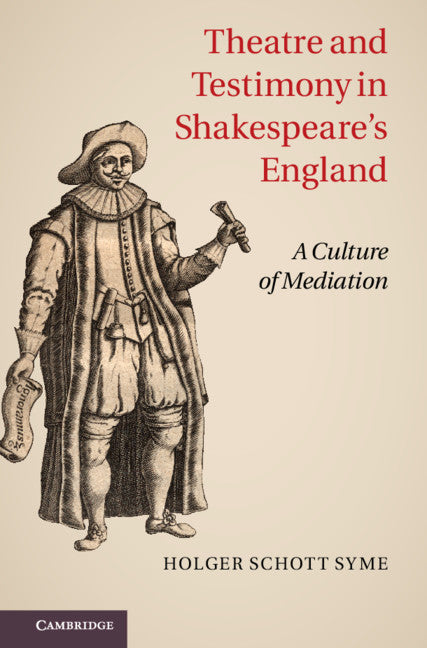
Freshly Printed - allow 10 days lead
Couldn't load pickup availability
Theatre and Testimony in Shakespeare's England
A Culture of Mediation
Holger Syme demonstrates why the theatre became the central form of cultural expression in Shakespeare's England.
Holger Schott Syme (Author)
9781107011854, Cambridge University Press
Hardback, published 1 December 2011
298 pages, 7 b/w illus.
23.5 x 16.3 x 2 cm, 0.62 kg
'Syme's analyses are profoundly revisionary, wonderfully original, even contrarian, and supported by a wealth of careful detail and intelligent and subtle readings. This may be one of those rare books that makes scholars reconsider what has become received wisdom about early modern performance and its means of authorization.' William N. West, Northwestern University
Holger Syme presents a radically new explanation for the theatre's importance in Shakespeare's time. He portrays early modern England as a culture of mediation, dominated by transactions in which one person stood in for another, giving voice to absent speakers or bringing past events to life. No art form related more immediately to this culture than the theatre. Arguing against the influential view that the period underwent a crisis of representation, Syme draws upon extensive archival research in the fields of law, demonology, historiography and science to trace a pervasive conviction that testimony and report, delivered by properly authorised figures, provided access to truth. Through detailed close readings of plays by Ben Jonson and William Shakespeare - in particular Volpone, Richard II and The Winter's Tale - and analyses of criminal trial procedures, the book constructs a revisionist account of the nature of representation on the early modern stage.
Introduction: the authenticity of mediation
1. Trial representations: live and scripted testimony in criminal prosecutions
2. Judicial digest: Edward Coke reads the Essex papers
3. Performance anxiety: bringing scripts to life in court and on stage
4. Royal depositions: Richard II, early modern historiography, and the authority of deferral
5. The reporter's presence: narrative as theatre in The Winter's Tale
Epilogue: the theatre of the twice-told tale
Select bibliography.
Subject Areas: Shakespeare studies & criticism [DSGS], Literary studies: general [DSB], Literary theory [DSA], Theatre studies [AN]