Freshly Printed - allow 10 days lead
Couldn't load pickup availability
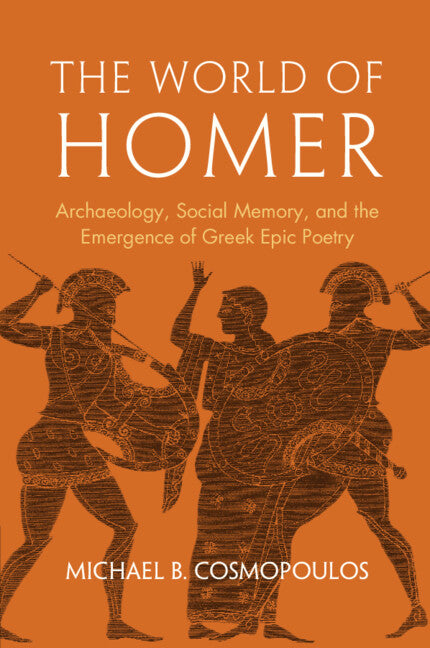
The World of Homer
Archaeology, Social Memory, and the Emergence of Greek Epic Poetry
Unravels the Homeric epics through a groundbreaking approach that illuminates their historical, cultural, and oral traditions.
Michael B. Cosmopoulos (Author)
9781009582889, Cambridge University Press
Hardback, published 19 June 2025
370 pages
23.7 x 16.1 x 2.3 cm, 0.76 kg
'The aim of this book is to 'offer a comprehensive, multidimensional exploration of the world of the Iliad and the Odyssey' by focusing on key scholarly debates, the many contexts of the Homeric poems, and the processes of memory and transmission behind them. Cosmopoulos achieves this aim using an interwoven interdisciplinary approach, which entails archaeology, history, philology, performance studies, and oral tradition. The scope of the book is immense … Recommended.' H. M. Roisman, CHOICE
Epic poetry, notably the Iliad and the Odyssey, stands as one of the most enduring legacies of ancient Greece. Although the impact of these epics on Western civilization is widely recognized, their origins remain the subject of heated debate. Were they composed in a single era or over the course of centuries? Were they crafted by one or by many poets? Do they reflect historical reality? These and other important questions are answered in this book. Using a fresh, dynamic approach, Michael Cosmopoulos reconstructs the world of the Homeric poems and explores the interplay between poetry, social memory, and material culture. By integrating key insights from archaeology, philology, anthropology, and oral tradition, he offers a nuanced perspective of the emergence and early development of Greek epic. His wide-canvas approach enables readers to appreciate the complexity of the Homeric world and gain a deeper understanding of the intricate factors that shaped these magnificent poems.
Introduction
Part I. Homeric Scholarship
1. Homer and Homeric studies
Part II. The World of Homer: 2. Historical background
3. Society and politics
4. Political geography
5. Economy
6. War
7. Religion
Part III. History, Memory and the Emergence of Greek Epic Poetry: 8. Historical elements in the epics
9. Social memory and epic composition.
Subject Areas: Classical Greek & Roman archaeology [HDDK]