Freshly Printed - allow 7 days lead
Couldn't load pickup availability
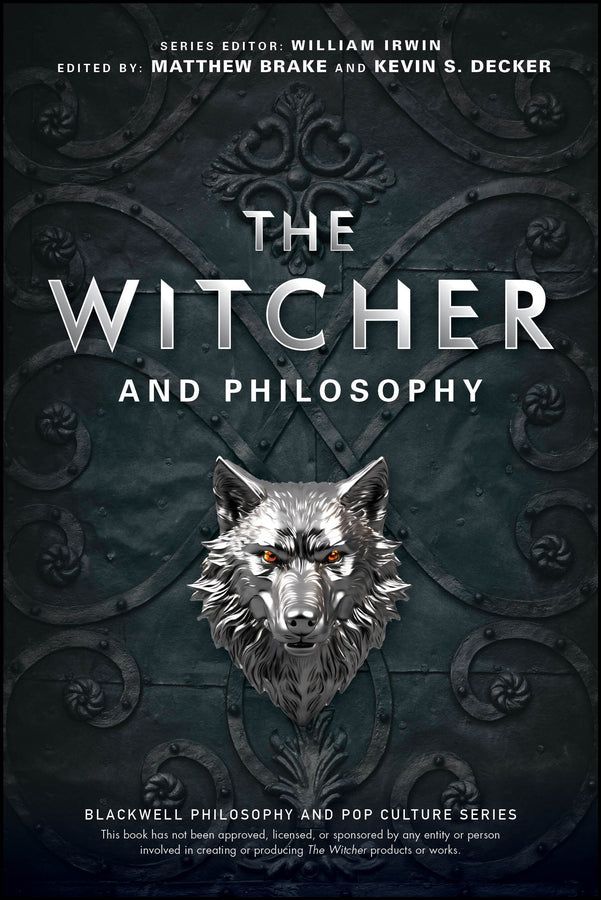
The Witcher and Philosophy
Toss a Coin to Your Philosopher
Matthew Brake (Edited by), Kevin S. Decker (Edited by)
9781394168736, Wiley
Paperback / softback, published 31 October 2024
272 pages
21.8 x 15 x 1.8 cm, 0.318 kg
Embark on a revealing philosophical journey through the universe of The Witcher “If I'm to choose between one evil and another, I'd rather not choose at all,” growls the mutant “witcher,” Geralt of Rivia. Andrzej Sapkowski's Witcher books lay bare the adventures of monster hunters like Geralt, who seek to avoid humanity's conflicts and live only for the next kill and the coin that comes with it. But Geralt's destiny is complicated by his relationship with a powerful sorceress, Yennefer of Vengerberg. When he connects with a displaced princess, Ciri, Geralt lands right in the middle of the political conflicts of the Continent, which is endangered by Nilfgaard, a domineering southern kingdom that threatens to conquer the world. Part of the Blackwell Philosophy and Pop Culture series, The Witcher and Philosophy brings on twenty-seven philosophers to test their mettle against werewolves, the bruxa, strigas, vodyanoi, and kikimora; their work addresses the phenomenally popular books, three standalone Witcher video games, and the hit Netflix streaming show. These authors pass on their fascination with all manner of horror and sorcery: the mutations that make Geralt and others witchers, the commonalities between the Continent and post-apocalyptic settings, the intricacies of political power and scandal in the world of The Witcher, and reflections of our own world's changing views on race and gender that might offer hope—or portend a grim future. Engaging and accessible, The Witcher and Philosophy considers key themes and questions such as: “Destiny is just the embodiment of the soul's desire to grow,” says Jaskier the bard, proving himself to be a natural philosopher. The tales of The Witcher remind us that our lives are a play written by both choice and destiny. And it is your destiny to read and be inspired by The Witcher and Philosophy.
Contributors viii Introduction: Toss a Coin to Your Witcher . . . and Your Philosopher xiv Ethics 1 1 A Friend of Humanity: On Mercenaries, Mutants, and Morals 3 2 The Witcher’s Dilemmas: Genuine or Apparent? 13 3 Lesser of Two Evils: Deliberation and the Witcher’s Moral Dilemma 22 4 Friendship in the Wild: Kant, the Witcher, and Curiosity 30 Free Will and Existentialism 37 5 Destiny, Fate, and the Law of Surprise: Determinism, Free Will, and The Witcher 39 6 Compatibilism and the Law of Surprise: Myth, Free Will, Destiny, and Hedgehogs 48 7 Silver or Steel?: Rethinking Rational Choice in an Irrational World 55 8 Nothing Is Ever Black and White: Existentialism in Witcher 3: The Wild Hunt 63 Feminism 71 9 “This Is the Version of Myself I Have to Be”: Understanding Yennefer’s Feminism(s) 73 10 “They Took My Choice, I Want It Back”: Infertility in The Witcher 84 11 Ciri’s Agency and Autonomy: Princess, Sorceress, and Witcher Girl 92 Race and Culture 101 12 Race and Racism in the World of The Witcher 103 13 Disadvantage, Demeaning, and Power: Is Geralt of Rivia Being Discriminated Against? 109 14 “I’m Part Elf, I’m Part Human”: Understanding Racism in The Witcher 117 Magic 127 15 Magic and the Elder Speech in The Witcher 129 16 Worlds within Words: Names and Naming in The Witcher 137 17 Between Two Camps in the Swamps of Velen: Platonism and Naturalism in the Worlds of The Witcher 146 18 “Witch Hunts Will Never Be About Witches”: Scapegoating and Stereotypes of Persecution 156 Postmodernism 165 19 The Witcher as Postmodern Fairytale 167 20 Shocks of Destiny: The Witcher’s Unlawful Surprise 177 21 Post-Apocalyptic Prognostications in The Witcher 184 Political Philosophy 195 22 King Foltest, John Locke, and Political Sovereignty in Temeria 197 23 Stolen Mutagens and Frustrated Neutrality: Carl Schmitt and “the Political” in The Witcher 205 24 Sometimes You Have to Pick Sides: Against Geralt’s Neutrality 214 Monsters 223 25 Origin and Desires as Monster Makers in The Witcher 225 26 The Witcher and the Monstrous Feminine 236 27 The Dialectics of Monstrosity 244 Index 253
Matthew Brake
Zachary Vereb
Walter Barta and Graham Lee
Corey R. Horn
Cisil Vardar
Graham Lee Copyrighted Material
Shane J. Ralston
Erin Williams and Darian J. Shump
Tim Miechels
Edwardo Pérez
Zoe L. Tongue
Emily Vega and Walter Barta
Gerald Browning
Wulf Loh
Edwardo Pérez
Andriy Ivanchenko
Fiona Tomkinson
Steven Kammerer
Ryan Smock
Emily Vega and Walter Barta
Corry Shores
Matthew Crippen
John P. Irish
Florian R.R. van der Zee
Matthew Brake
Julie Loveland Swanstrom and Victoria Lyle
Yael Cameron
Paul Giladi
Subject Areas: Philosophy [HP]