Freshly Printed - allow 7 days lead
Couldn't load pickup availability
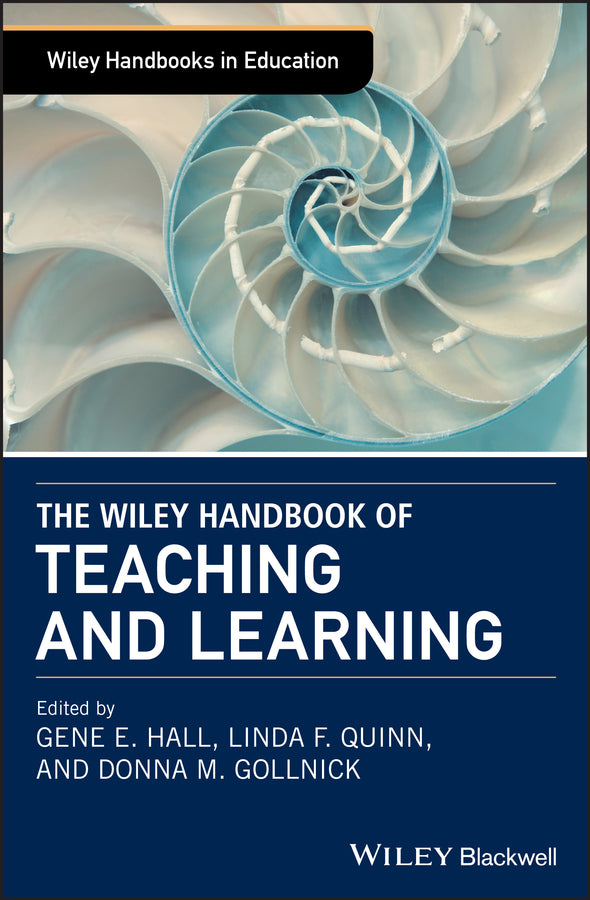
The Wiley Handbook of Teaching and Learning
Gene E. Hall (Edited by), Linda F. Quinn (Edited by), Donna M. Gollnick (Edited by)
9781118955871, Wiley
Hardback, published 24 August 2018
704 pages
25.2 x 17.8 x 3.8 cm, 1.179 kg
Provides a comprehensive reference for scholars, educators, stakeholders, and the general public on matters influencing and directly affecting education in today’s schools across the globe This enlightening handbook offers current, international perspectives on the conditions in communities, contemporary practices in schooling, relevant research on teaching and learning, and implications for the future of education. It contains diverse conceptual frameworks for analyzing existing issues in education, including but not limited to characteristics of today’s students, assessment of student learning, evaluation of teachers, trends in teacher education programs, technological advances in content delivery, the important role for school leaders, and innovative instructional practices to increase student learning. The Wiley Handbook of Teaching and Learning promotes new, global approaches to studying the process of education, demonstrates the diversity among the constituents of schooling, recognizes the need for and presents a variety of approaches to teaching and learning, and details exemplary practices in education. Divided into four sections focused on general topics—context and schooling; learners and learning; teachers and teaching; and educators as learners and leaders—and with all-new essays that look at what has been, what is, and what could be, this book is destined to inspire thoughtful contemplation from readers about what it means to teach and learn. Scholars from around the world provide a range of evidence-based ideas for improving and modifying current educational practices, making The Wiley Handbook of Teaching and Learning an important book for the global education community and those planning on entering into it.
Notes on Contributors ix Introduction: Issues Affecting Teaching and Learning in Today’s Schools 1 Part 1 The Context of Schooling 5 1 The Complexity of American Teacher Education 7 2 School Reform—A Never‐Ending Story: Avoiding Attractive Pitfalls and Exploring Promising Perspectives 29 3 The Culture and Teaching Gap: What Is It, and How Can Teacher Educators Help to Close It? 59 4 The Role of the Community in Learning and Development 79 5 Building Capacity in Order to Strengthen Teaching and Learning 107 6 Implementing and Sustaining Language Curriculum Reform in Singapore Primary Schools 151 Part 2 Learners and Learning 173 7 Educational Neuroscience: Are We There Yet? 175 8 Turning Toward Students: Adopting a Student‐Centered Stance in Mandate‐Centered Times 199 9 Learning Anytime, Anywhere through Technology: Reconsidering Teaching and Learning for the iMaker Generation 225 10 The Place of Learning in the Systematization and Standardization of Early Childhood Education 257 11 Exceptional Education is Special 277 12 Case Study: Nevada’s English Language Learner Strategy: A Case Study on Policymaking and Implementation 301 Part 3 Teachers and Teaching 321 13 Next Generation Research in Dialogic Learning 323 14 Guiding and Promoting Student Learning: Applying Theory to Practice 339 15 A Smile is Universal: Building Sensitivity to and Understanding of Culturally and Linguistically Diverse Learners through International Field Experiences 365 16 Envisioning Alternative Futures: Elliot Eisner’s Challenge to Industrial Educational Practice 391 17 CASE STUDY: Trajectories in Developing Novice Teacher Leadership Potential: A Tale of Two Countries 417 18 CRITIQUE: What Effect Size Doesn’t Tell Us 431 Part 4 Educators as Learners and Leaders 445 19 The Importance of Teacher Induction for Improving Teaching and Learning 447 20 Teacher Leadership: Past, Present, and Future 473 21 Principal Instructional Leadership: From Prescription to Theory to Practice 505 22 Case Study: Restorative Justice: An Alternative Approach to School Discipline 529 Part 5 Evaluation and Assessment 549 23 Back to the Future: Assessment from 1990 to 2016 551 24 Views of Classroom Assessment: Yesterday, Today, and Tomorrow 577 25 Rethinking Teacher Quality in the Age of Smart Machines 603 26 Rethinking the Intersection of Instruction, Change, and Systemic Change 619 27 CRITIQUE: On the Limits to Evidence‐Based Learning of Educational Science 639 Epilogue: Reflections of the Co‐Editors 661 Index 663
Gene E. Hall, Linda F. Quinn, and Donna M. Gollnick
David Imig, Scott Imig, Michael Neel, and Loretta Holmberg‐Masden
Roland Vandenberghe
Roderick L. Carey, Abiola Farinde‐Wu, H. Richard Milner IV, and Lori Delale‐O’Connor
Elizabeth Spier, Raquel L. González, and David Osher
Sharon Harsh
Jason Loh and Foong Poh‐Yi
John T. Almarode and David B. Daniel
Alison G. Dover and Brian D. Schultz
Timothy D. Green and Loretta C. Donovan
Susan Grieshaber and Sharon Ryan
Dena D. Slanda and Mary E. Little
Magdalena Martinez
Lauren B. Resnick, Christa S. C. Asterhan, and Sherice N. Clarke, with Faith Schantz
LeAnn G. Putney, Connie L. Malin, Teresa Miller, Sarah Crosby, and Bobbie Stanley
Amanda J. Laichak
Richard Siegesmund
Ping Gao
Barrie Bennett
Matthew C. Nishimoto
Barnett Berry
Philip Hallinger
Tom Cavanagh
Elliott Asp
Julie Oxenford‐O’Brian and Kay P. Uchiyama
Yong Zhao
Barrie Bennett and Stephen Anderson
James G. Ladwig
Gene E. Hall, Linda F. Quinn, and Donna M. Gollnick
Subject Areas: Education [JN]