Freshly Printed - allow 10 days lead
Couldn't load pickup availability
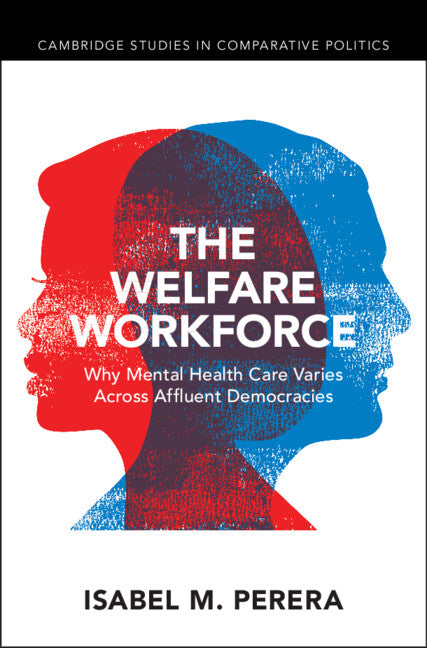
The Welfare Workforce
Why Mental Health Care Varies Across Affluent Democracies
Examines how labor-organizing among welfare workers has contributed to the success, or failure, of mental health care systems.
Isabel M. Perera (Author)
9781009499897, Cambridge University Press
Hardback, published 16 January 2025
288 pages
22.9 x 15.2 x 1.8 cm, 0.579 kg
'Masterfully marshaling comparative evidence and reasoning, Perera proves that because the mentally ill are a politically silent minority, and because more populous and economically powerful interest groups have little at stake, the agents, causal pathways, and outcomes in mental health policy deviate strikingly from patterns of change across countries in more extensively researched welfare state arenas.' Peter Swenson, Charlotte Marion Saden Professor of Political Science, Yale University
The Welfare Workforce is a thought-provoking exploration of mental health care in the United States and beyond. Although all the affluent democracies pursued deinstitutionalization, some failed to provide adequate services, while others overcame challenges of stigma and limited resources and successfully expanded care. Isabel M. Perera examines the role of the “welfare workforce” in providing social services to those who cannot demand them. Drawing on extensive research in four countries – the United States, France, Norway, and Sweden – Perera sheds light on post-industrial politics and the critical part played by those who work for the welfare state. A must-read for anyone interested in mental health care, social services, and the politics of welfare, The Welfare Workforce challenges conventional wisdom and offers new insights into the complex factors that contribute to the success or failure of mental health care systems. This title is also available as Open Access on Cambridge Core.
1. The welfare workforce: managers and workers make strange bedfellows
2. Nowhere to go? The supply of mental health services across countries
3. Before deinstitutionalization: the United States and France compared
4. Deinstitutionalization in the United States
5. Deinstitutionalization in France
6. Deinstitutionalization elsewhere: a Scandinavian check
7. Beyond deinstitutionalization: welfare workers and welfare capitalism
Postscript: the evolving definition of the 'welfare workforce'
Appendix. Comparative deinstitutionalization data set: codebook and source information.
Subject Areas: Comparative politics [JPB]