Freshly Printed - allow 8 days lead
Couldn't load pickup availability
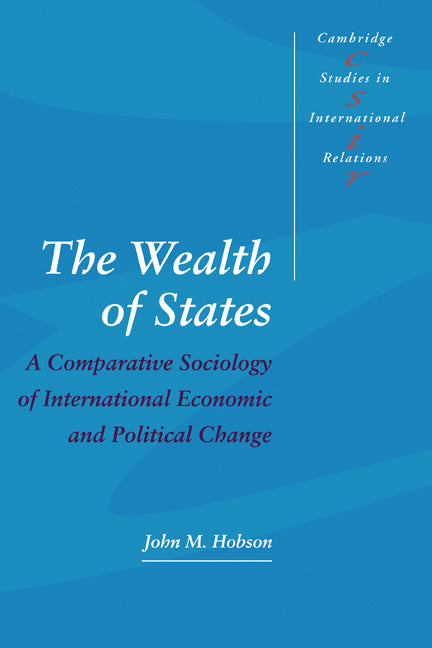
The Wealth of States
A Comparative Sociology of International Economic and Political Change
The Wealth of States is the first sustained analysis of the overlap between historical sociology and international relations.
John M. Hobson (Author)
9780521581493, Cambridge University Press
Hardback, published 6 March 1997
364 pages, 18 b/w illus. 45 tables
23.6 x 15.8 x 2.6 cm, 0.66 kg
"...useful insights and important correctives to conventional (Marxist and liberal) arguments..." George Modelski, American Jrnl of Sociology
In recent years a number of scholars of international relations have developed an interest in neo-Weberian historical sociology, but The Wealth of States is the first sustained analysis of the overlap between historical sociology and international relations. John Hobson develops a new theory of international change using a sociological approach, through a detailed examination of nineteenth-century trade regimes, and the efforts of the Great Powers to increase their military capabilities before the First World War through tariff protectionism. His analysis reveals the importance of the state as an autonomous, 'adaptive' actor in international politics and economics, which is not dependent upon dominant economic classes. The book thus represents a distinctive approach which goes beyond the existing paradigms of marxism, liberalism, and realism.
1. A sociology of international relations and an international relations of sociology
Part I. Case Studies in Structural Economic Change: States and Trade Regime Changes, 1870–1913
2. Protectionism in Imperial Germany: moderate state capacity and indirect taxation
3. Protectionism and industrialism in Tsarist Russia: weak state capacity and indirect taxation
4. Free trade versus protectionism in liberal Britain: strong state capacity and the conflict over taxation
5. Protectionism and indirect taxation in federal states: USA, Canada, Australia and Switzerland
Part II. Theorizing International and National Structural Economic and Political Change: 6. A sociological theory of international economic change: the transition to tariff protectionism, 1870–1913
7. State capacity in the international/national vortex: a non-realist theory of state power and international politics.
Subject Areas: International relations [JPS]