Freshly Printed - allow 7 days lead
Couldn't load pickup availability
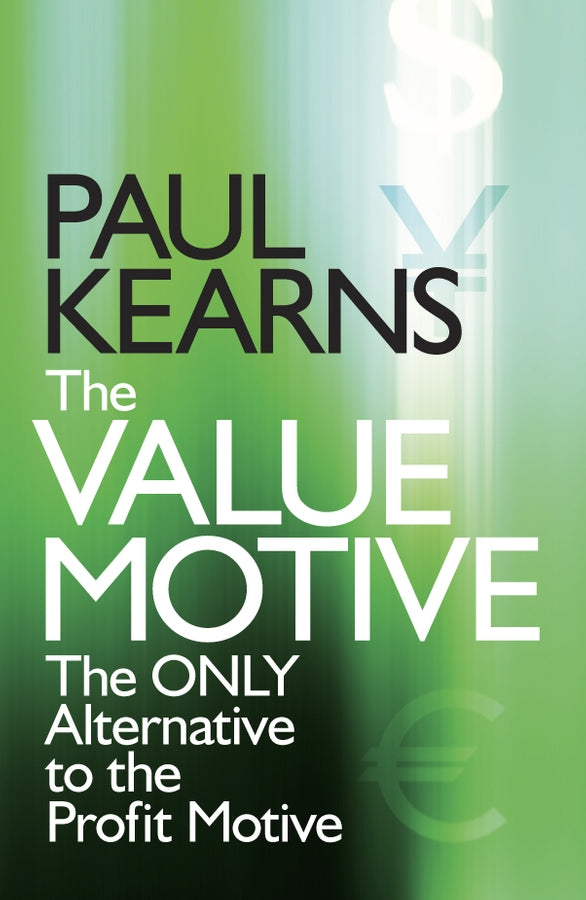
The Value Motive
The Only Alternative to the Profit Motive
Paul Kearns (Author)
9780470057551, Wiley
Hardback, published 23 March 2007
288 pages
23.6 x 16 x 2.1 cm, 0.544 kg
"â?¦readable and thought-provokingâ?¦" (CPO Agenda, June 2007)
"...this book should be compulsory for all HR Professionals" (Personnel Today, Tues 3rd May)
Our market system has evolved in line with capitalist philosophy, and at its heart is profit. But while profit can be a powerful motive, it is not always used responsibly and, in the worst cases, this can have damaging effects at a wider level. The calls for a corporate conscience grow louder, but no one has yet suggested an alternative to profit that people find as compelling. Profit is here and now. In this climate, the solution is to refine the profit motive, not replace it. We all value things, and we’re all motivated by what we value. If value could replace the profit motive, it would reconcile the interests of CEOs, shareholders, citizens and government. Profits would still rise but at the same time society would gain value. This book is a call to manage for maximum value – to follow The Value Motive. Kearns Endorsements "In 'The Value Motive,' Paul Kearns clarifies the confusing concept of 'value' and shows how it can be used to transform thinking and action in organizations. Paul's books are always stimulating and controversial, and this one is no exception. If you are interested in creating more value in your organization and willing to have your existing mental models challenged, then you should read this book!" "I have worked with a host of HR professional over the years. To date I know of noone that compares to Paul when it comes to presenting the issues and challenges of managing human capital and providing practical approaches for doing so. Like his past books, The Value Motive, brings clarity to a world of HR, which often is filled with disarray and recommendations that tend to be driven by political correctness rather than by the intent to produce value. Paul's discussion of value as a driving force in organizations (in addition to profit) brings together the worlds of for and not for profit organizations. It also provides an overarching theme that includes the best interest of all stakeholders, customers, community and shareholders alike. This certainly represents a very much needed approach." "This is a timely, forward-looking, and convincing exposition delving into why value is a better determination of sustained ROI than profit. Paul provides simple, yet valid methodology regarding how much value is added by any organizational activity. His writings are a must for anyone measuring the true effectiveness of people development, an organization’s primary value-added activity."
—Dean Spitzer, Performance Measurement Thought Leader, IBM Research, and author of "Transforming Performance Measurement" USA
—Finnur Oddsson, Ph.D., Director of MBA Programs & Executive Education, Reykjavík University, Iceland
—Tery Tennant, Attainment, Inc, USA
About The Author ix Preface xi Introduction xix 1 Profit Is Not a Dirty Word But Value Is Much Cleaner 1 Is profit the best way to allocate scarce resources? 1 Profit can be a very emotive word 7 The Microsoft Paradox 11 Not-for-profit? Does that mean not-for-value? 17 Profit is an increasingly unpopular king 22 2 Value – A Very Slippery Word Indeed 29 Defining value 29 A working definition of value 34 Basic value 37 Moving on to added value 41 Private equity partners – value adders or asset strippers? 44 The value motive already exists 47 Value as a distillation process 51 Declaring value in a public statement 54 The value agenda 62 A value statement for a commercial company 63 A value statement for a public sector organization 68 ‘Intangibles’ confuse the issue of added value 71 3 This Powerful Motive Force We Call Value 77 Harnessing the power of motive 77 Value means output, not input 80 Defi ning value as an economic system 85 Does the capitalist system deliver the best value? 88 When we say value we should really mean it 92 A holistic value system for everyone 96 4 Value Has to Be The Raison D’être For Every Type of Organization 101 All value is good 101 Value is the raison d’être of all organizations 103 Corporate social responsibility (CSR) and the ‘triple’ bottom line 106 Social enterprise 117 Is the public sector an obsolete construct? 120 5 Organizational Performance Measurement Has to Measure Value 127 Turning human activity into value 127 The advent of the scorecard 130 The EFQM business excellence model 134 Agreeing value priorities using the 3 Box System 136 The gulf between performance measurement theory and practice 142 Activity, performance and added value measures 150 Taking a fresh perspective on the purpose of performance measurement 153 Measuring and managing ‘intangibles’ 156 E-valu-ation 161 6 Value Is Essentially A People Thing 167 A fresh approach to people management 167 Measuring the value of people 171 Debunking the employee–customer–profit chain theory 176 Replacing performance management with value management 178 Managing value holistically 185 Valuing people ‘intangibles’ 187 7 The People Measurement ‘Box’ 193 Only meaningful measures count 193 People measurement is a really serious matter 199 Does diversity add value? 205 Human capital management, a revolution in management thinking 210 People – are they personnel, human resources, assets or capital? 214 Human capital measures and indicators of value 216 8 How The Value Motive Could Upstage The Profit King 223 The value motive is leadership 223 The politician’s definition of value 231 The first, second and third sectors have to become one 236 Value special cases and dead losses 241 Value management education 245 Auditing the value motive 249 A new management discipline – valuing the human contribution 252 Index 259
Subject Areas: Business & management [KJ]