Special Order - allow 2+ weeks lead
Couldn't load pickup availability
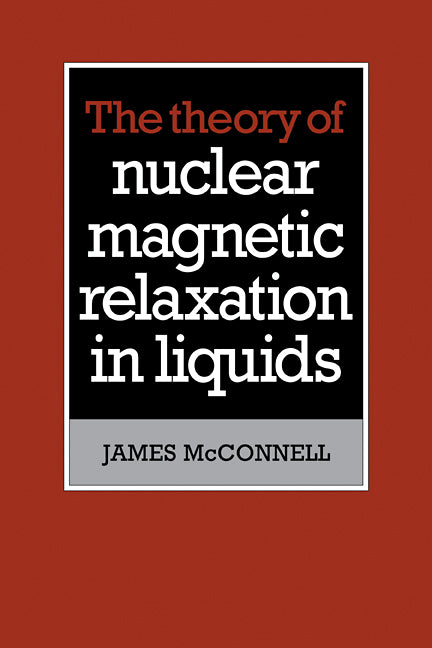
The Theory of Nuclear Magnetic Relaxation in Liquids
This book provides a complete exposition of the theory of nuclear magnetic relaxation caused by the thermal motion of the molecule containing the relaxing nucleus.
James McConnell (Author)
9780521107716, Cambridge University Press
Paperback / softback, published 5 March 2009
208 pages
22.9 x 15.2 x 1.2 cm, 0.32 kg
This book provides a complete exposition of the theory of nuclear magnetic relaxation caused by the thermal motion of the molecule containing the relaxing nucleus. The author begins by defining the physical quantities encountered in nuclear magnetic resonance studies and surveying pioneering investigations in the field. Nuclear magnetic relaxation by scalar, dipolar, quadrupolar and spin-rotational interactions and by anisotropic chemical shift are then examined in detail. Relaxation rates are expressed in terms of spectral densities, and the values of the spectral densities for various molecular shapes are calculated by random walk or Brownian motion dynamics. The text should be within the grasp of readers who have taken undergraduate courses in electromagnetic theory and in classical and quantum mechanics, although topics in these fields of particular relevance are to be found in appendices. This book will be of value to postgraduate students and research workers using n.m.r. in physics and physical chemistry departments, and by scientists in industrial and medical research.
1. Phenomenological theory of relaxation
2. Random motion
3. Equations of relaxation theory
4. Dipolar interactions
5. Relaxation by intermolecular dipolar interactions
6. Relaxation by Intramolecular dipolar interactions
7. Relaxation by scalar interaction
8. Relaxation by chemical shift
9. Relaxation by quadrupole interaction
10. Relaxation by spin-rotational interaction
11. Theory and experiment for relaxation processes.
Subject Areas: Condensed matter physics [liquid state & solid state physics PHFC]