Freshly Printed - allow 7 days lead
Couldn't load pickup availability
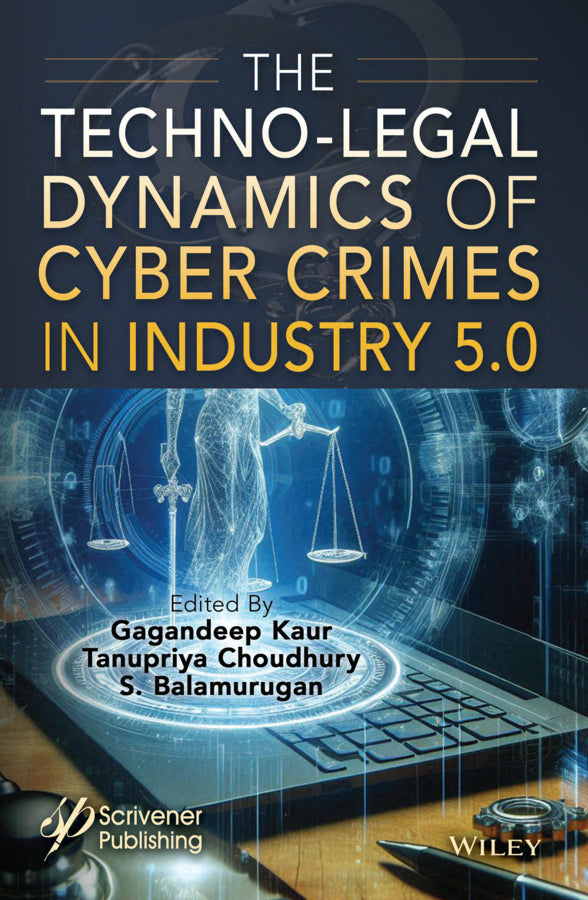
The Techno-Legal Dynamics of Cyber Crimes in Industry 5.0
Gagandeep Kaur (Edited by), Tanupriya Choudhury (Edited by), S. Balamurugan (Edited by)
9781394242146, Wiley
Hardback, published 21 March 2025
416 pages
25 x 15 x 1.5 cm, 0.68 kg
This book explores the core principles, technological advancements, and legal challenges of Industry 5.0’s digital transformation. Industry 5.0 has enhanced the operational efficiency of the entire manufacturing process by incorporating multiple emerging technologies; however, high-tech cybercrimes have prompted legal scholars worldwide to rethink the fundamental principles of technology and law. The Techno-Legal Dynamics of Cyber Crimes in Industry 5.0 shows how advanced technologies, such as artificial intelligence, the Internet of Things, and robotics, are integrated within manufacturing environments. It explores the intricate relationship between legal systems and technological advancements and addresses the rise of cybercrime following Industry 5.0’s digital transformation. Focusing on the interaction between technology and law, the book investigates current cyberlaw issues and solutions. It draws insights from diverse experts, including scholars, legal professionals, and industry leaders, emphasizing effective regulations to minimize cyber threat risks for Industry 5.0. By adopting an international viewpoint, this book sheds light on various dimensions of nascent cybercrimes and legislative efforts worldwide aimed at governing them effectively. Audience
This book should be read by legal scholars, lawyers, judges, legal and information technology researchers, cybersecurity experts, computer and software engineers, and students of law and technology. Regulators, policymakers, international trade specialists, and business executives should read it as well.
Preface xv 1 AI & IP: Ownership Rights in Industry 5.0 1 1.1 Introduction 2 1.2 Evolution of Artificial Intelligence System 4 1.3 Rights Upon the Fruits of AI: #TheConundrum 8 1.4 The Antidote to Conundrum: Work Made for Hire (WMFH) Model 12 Conclusion 16 References 17 2 Cybersecurity and Crime in Industry 4.0: An Analysis of Legal Aspects of Cybercrime 19 2.1 Introduction 20 2.2 Industry 4.0 21 2.3 Cybercrime in the Digital Economy 22 2.3.1 Cybercrime and Organization 24 2.4 Cybercrime Statistics—Global Context 24 2.4.1 Cybercrime—Indian Context 25 2.4.2 Government Initiatives to Curb Cyber Frauds 26 2.4.3 Cybercrime Trends with Statistics 27 2.5 Cybersecurity 30 2.5.1 Measures to Protect from Cyberattacks 31 2.6 Legal Perspectives of Cybercrime and Their Penalty-Cases 32 2.6.1 Legal Aspects of Cybercrimes with Cases 34 2.7 Challenges of Cybersecurity 36 2.8 Conclusion 38 References 39 Weblinks 41 Case Links 41 3 Toward an Intelligent Cybersecurity System: The Role of Machine Learning 43 3.1 Introduction 44 3.2 Machine Learning Paradigms 45 3.3 Machine Learning Applications 46 3.4 Machine Learning Applications in Cybersecurity 47 3.5 Machine Learning in Cybersecurity—Few Cases 48 3.6 Issues and Limitations of Machine Learning in Cybersecurity 51 3.7 Future Directions 52 3.8 Conclusion 53 References 54 4 ATP the New-Age Threat Vector and Cyberattack Trends 55 4.1 Introducing Advanced Persistent Threats 55 4.2 New-Age APT Attacks 58 4.3 Cyberattacks Trends 65 4.4 Reconnaissance 68 4.5 Initial Compromise 69 4.6 Establishing a Foothold 72 4.7 Exfiltration 73 4.8 Consolidation 75 4.9 Covering Tracks 76 4.10 Conclusion 77 References 78 5 Online Privacy in Artificial Intelligence Algorithms: Ethical and Legal Impacts of Technological Development and Exposure 79 5.1 Introduction 80 5.2 Understanding Artificial Intelligence 83 5.3 Impact of Artificial Intelligence on Personal Data 85 5.4 General Data Protection Regulation and Artificial Intelligence 88 5.5 Right to be Forgotten: Legal and Ethical Considerations of Data Processing by an AI 91 5.5.1 Can AI Actually Forget? 94 5.5.2 Privacy by Design 95 5.6 Conclusion 97 References 98 6 Exacerbation and Combat of Cyberattacks: The Dual Paradox of Machine Learning 101 6.1 Introduction 102 6.2 Concept of Machine Learning 103 6.3 Technologies Involved in Machine Learning and Their Impact on Cybersecurity 106 6.3.1 Big Data 106 6.3.2 Blockchain Technology 107 6.3.3 User and Entity Behavioral Analytics (UEBA) 108 6.4 Growing Role of Machine Learning in Cybersecurity 108 6.5 Applications of Machine Learning in Cybersecurity 109 6.6 Demerits of Using Machine Learning in Cybersecurity 112 6.7 Legal Framework for Cybersecurity in India 113 6.7.1 The Information Technology Rules (IT Rules) 114 6.7.2 The Digital Personal Data Protection Act, 2023 114 6.7.3 Indian Computer Emergency Response Team (CERT-IN) 115 6.8 Conclusion 115 References 117 7 Hacking the System: A Deep Dive into the World of E-Banking Crime 121 7.1 Introduction 122 7.2 Literature Review 124 7.2.1 Cyber Risk in the Financial Industry 124 7.2.2 E-Banking Crime 126 7.2.3 Reasons for the Rise in E-Banking Crimes 129 7.2.3.1 Theoretical Perspectives on the Rise in E-Banking Crimes 130 7.2.4 Impact of E-Banking Crimes on the Financial Sector 131 7.2.4.1 Theoretical Perspectives on the Impact of E-Banking Crimes 133 7.3 Combating E-Banking Crimes 135 7.3.1 Challenges in Combating E-Banking Crimes 136 7.4 E-Banking Crimes: Emerging Economies 138 7.4.1 India 140 7.4.2 Nigeria 141 7.5 Conclusion 142 References 144 8 Is Love a Crime-Decoding Cybercrimes in Online Dating and Risk Mitigation 149 8.1 Introduction to Online Dating 150 8.1.1 The “Cons” of Online Dating 151 8.1.2 Do the Pros Outweigh the Cons? 152 8.2 Cybercrimes via Online Dating 153 8.3 Exploring the Law of India 159 8.3.1 Privacy and Online Dating 160 8.4 Laws Governing Dating Apps in India 161 8.4.1 The Constitution of India 161 8.4.2 The Indian Penal Code 1860 162 8.4.3 Information Technology Act 2000 162 8.4.4 Personal Data Protection Bill 2022 163 8.5 A Ray of Hope—is Mitigation Possible 165 References 167 9 Critical Analysis of the Role of Intermediaries with Respect to Cybercrimes in Cyberspace 171 Introduction 172 References 196 10 Cybercrime and AI: Issues and Solutions 199 10.1 Introduction 200 10.1.1 Definition 200 10.2 Literature Review 202 10.3 Nature of Artificial Intelligence 206 10.4 Artificial Intelligence Tools for Cybersecurity 209 10.5 Legal Challenges 211 10.6 Comparison of Indian and International Law 215 10.7 Conclusion 228 10.8 Suggestions 229 References 231 11 The Illusion of Bitcoin: The Rise and Fall of a Revolutionary Cryptocurrency 237 11.1 Mystery of Bitcoin: An Overview 238 11.1.1 What is Bitcoin? 238 11.1.2 History of Bitcoin 239 11.1.3 Bitcoin and the Economic Enterprise 239 11.2 The Rise and Fall of Bitcoin 240 11.2.1 Gaining Popularity 241 11.2.2 Losing Pursuit 242 11.3 The Illusion of Bitcoin 243 11.4 Bitcoin and Cybersecurity 244 11.4.1 Decentralization and Its Potential Security Weaknesses 245 11.4.2 Vulnerabilities in Bitcoin Wallets 245 11.4.3 Cybersecurity Issues in Bitcoin Exchanges 245 11.4.4 Blockchain Attacks and Manipulation 246 11.5 Measures to Enhance Bitcoin Security 246 11.5.1 Multi-Factor Authentication 246 11.5.2 Encryption 247 11.5.3 Decentralized Storage 247 11.5.4 Cold Storage 247 11.5.5 Multi-Sig Wallets 247 11.6 Case Studies of Bitcoin Security Breaches 248 11.6.1 Mt. Gox Hack 248 11.6.2 Bitfinex Hack 248 11.6.3 Nicehash Hack 248 11.6.4 Dao Hack 249 11.6.5 Parity Wallet Hack 249 11.7 Bitcoin and the Financial Industry 249 11.7.1 Impact of Bitcoin on the Economic Enterprise 250 11.7.2 Indian Economy 250 11.7.3 International Economy 252 11.8 Social and Political Implications of Bitcoin 253 11.9 Bitcoin’s Role in Crime 255 11.10 The Future of Bitcoin 257 11.10.1 Improved Security Measures 258 11.10.2 Bitcoin Regulations 258 11.10.3 Artificial Intelligence 258 11.10.4 Quantum Computing 258 11.10.5 Emergence of New Cryptocurrencies 259 11.11 Conclusion 259 11.12 Way Forward 260 References 261 12 Cybercrime Against Women in India: Challenges and Possible Solutions 265 12.1 Introduction 266 12.2 History and Origin of Cybercrimes 267 12.3 Literature Review 268 12.4 Reasons for the Growth of Cybercrimes Against Women 269 12.4.1 Psychological Reason 269 12.4.2 Sociological Reasons 270 12.4.3 Lack of Awareness in India 271 12.4.4 Knowledge of Computer 271 12.4.5 Easy Availability and Addiction to the Internet 271 12.5 Different Types of Cybercrime Against Women 273 12.5.1 Cyber Harassment 273 12.5.2 Cyber Pornography 273 12.5.3 Cyberstalking 274 12.5.4 Cyber Defamation 274 12.5.5 Morphing 275 12.5.6 Email Spoofing 275 12.6 Implication of Cybercrimes on Women 275 12.7 Legal Provisions Against Cybercrimes 276 12.8 Provisions for Cybercrimes Under IT ACT 2000 277 12.9 Landmark Cases in Cybercrime Against Women 278 12.9.1 Jayanta Kumar Das Versus State of Odisha 278 12.9.2 Fatima Riswana Versus State Rep. by A.C.P., Chennai & Ors 38 278 12.9.3 State of Tamil Nadu Versus Suhas Kutti 279 12.9.4 Avnish Bajaj Versus State (N.C.T.) of Delhi 279 12.10 Shortcomings in the Indian Legal System 280 12.11 Suggestions 281 Conclusion: A Way Forward 282 References 283 13 Emerging Legal Challenges in the Artificial World of Metaverse 285 13.1 Introduction 286 13.2 The Ideas Behind the Metaverse 288 13.2.1 The Market of the Metaverse 289 13.3 The Application of the Metaverse in Different Industries 290 13.3.1 Potential Benefits of the Metaverse 291 13.4 Issues and Challenges after Introducing the Metaverse 293 13.5 Approaching Metaverse Problems from a Global Perspective 298 13.5.1 Preview of the Judicial Trail Map in the U.S. 298 13.6 Conclusion 305 References 305 14 Cyberterrorism: In an Era of Information Warfare 309 14.1 Introduction 310 14.2 The Surge in Cyberterrorism 310 14.3 Background 311 14.3.1 Meaning and Definition of Cyberterrorism 311 14.3.2 Dynamics of Cyberterrorism and Cyberterrorist Attacks 311 14.3.3 Terrorist Attacks 312 14.3.4 Cyberterrorism: Definitions 313 14.3.5 Origin of Cyberterrorism 314 14.4 Methodology Used 314 14.5 Effects of Cyberterrorism on Society and Government 315 14.6 Techniques and Methods Used for Cyberterrorism 317 14.7 Countries Affected the Most by Cyberterrorism 320 14.8 Ukraine and Russia War and Cyberterrorism 321 14.9 Combating Cyberterrorism 324 14.9.1 Indian Law Dealing with Cyberterrorism 324 14.9.2 International Law Dealing with Cyberterrorism 326 14.10 Conclusion 327 References 327 15 Freedom of Speech and Expression on Social Media— A Comparison of India and China 331 15.1 Introduction 332 15.1.1 Why Protect Freedom of Speech? 335 15.1.2 Why Restrict (Regulate) Speech? 335 15.2 Review of Literature 336 15.3 Online Speech Regulations—India vs. China 341 15.3.1 Online Speech Regulations in India 341 15.3.2 Online Speech Regulations in China 342 15.4 Intermediary Responsibilities—India vs. China 343 15.4.1 Responsibilities of Social Media Intermediaries in India 343 15.4.1.1 Government Departments as Intermediaries 345 15.4.2 Responsibilities of Social Media Intermediaries in China 346 15.5 Conclusion 346 References 348 16 Environment and Cybercrime in the World: Mitigating the Impact of Cybercrime on the Environment 351 16.1 Introduction 352 16.1.1 What is Cybercrime? 352 16.1.2 Importance of the Topic 353 16.1.3 Overview of the Chapter 353 16.2 Impact of Cybercrime on the Environment 353 16.2.1 Production of E-Waste 353 16.2.2 Use of Energy 355 16.2.3 Financial and Economic Systems 356 16.2.4 Damage to Critical Infrastructure 356 16.3 Mitigating the Impact of Cybercrime 358 16.3.1 Awareness Raising and Best Practices for Cybersecurity 358 16.3.2 Responsible Disposal of Electronic Waste 360 16.3.3 Energy-Efficient Technologies 361 16.3.4 Government and Company Policies 362 16.4 Future of the Environment and Cybercrime 364 16.4.1 Emerging Trends in Cybercrime 364 16.4.2 The Role of Technology in Protecting the Environment 365 16.4.3 Collaboration and International Cooperation 367 16.5 Conclusion 368 References 368 17 Face Recognition Based on Smart Attendance System Using Python 373 17.1 Introduction 374 17.2 Methodology 376 17.3 Face Database 379 17.4 Implementation of CNN and SVM Algorithm 382 17.5 Features and Benefits Features of the System 388 17.6 Conclusion 389 References 390 Index 393
Pulkit Mogra
Jeevesh Sharma and Ashima Jain
Oly Mishra and Vijaya Geeta Dharmavaram
Akashdeep Bhardwaj and Sam Goundar
Aditi Bharti and Gagandeep Kaur
Devika Sharma and Saket Sharma
Swati Gupta
Latika Choudhary and Hardik Daga
Anwesha Pathak
Gagandeep Kaur, Darashiny Nivasan and Tanupriya Choudhury
Ravi Kant
Avneet Kaur
Rajesh Kumar and Megha M. Patel
Mohamad Ayub Dar and Megha Ojha
Sanyogita Singh and Vikram Singh
Pracheta Rathore and Jai Malaviya
P. Monisha, Prakash N., E. Udayakumar, Tamilselvan S. and Kumareshan N.
Subject Areas: Computer networking & communications [UT]