Freshly Printed - allow 7 days lead
Couldn't load pickup availability
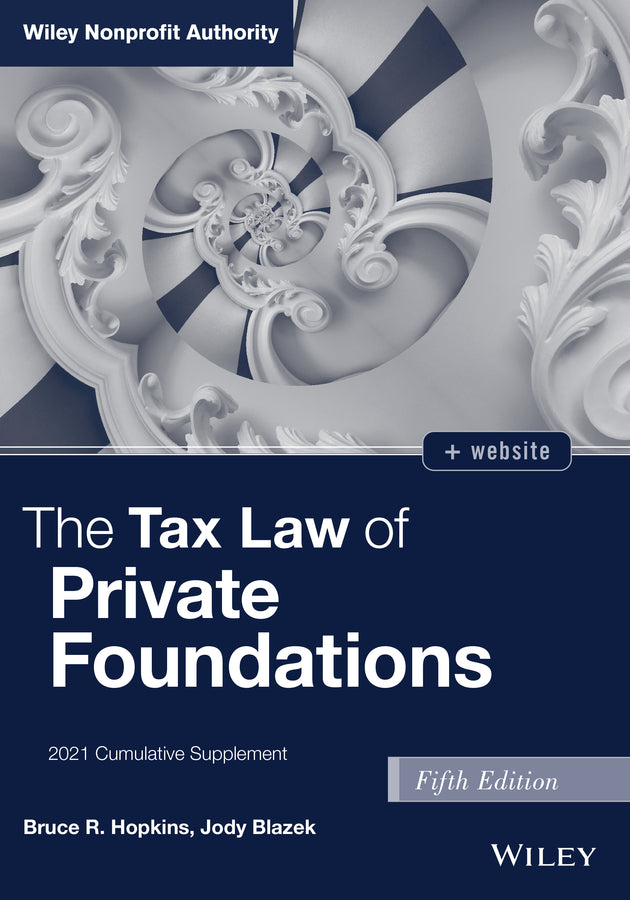
The Tax Law of Private Foundations
2021 Cumulative Supplement
Bruce R. Hopkins (Author), Jody Blazek (Author)
9781119804338, Wiley
Paperback / softback, published 12 November 2021
224 pages
24.6 x 17.5 x 1.8 cm, 0.363 kg
The Tax Law of Private Foundations, 2021 Cumulative Supplement, 5th Edition Make sense of the new regulatory requirements with expert clarification and practical tools for compliance Private Foundations: Tax Law and Compliance, 5th Edition provides clarification, expert insight, and helpful instruction for executives and supporting professionals navigating extensive federal tax law requirements. Despite their relatively low numbers, private foundations are subject to complex, burdensome regulations that continue to expand; the recent tax overhaul has compounded this issue, bringing massive changes beyond the usual annual adjustments, and throwing a wrench into the status quo of compliance-as-usual. This book summarizes and clarifies the statutory regulations governing private foundations, offers expert insight into the underlying logic, and provides a host of practical tools that ease the filing process and help ensure compliance with the latest laws. Detailed explanations are bolstered by checklists, sample documents and letters, practice forms, and real-world examples in order to provide both conceptual and practical guidance for maintaining tax-exempt eligibility and tax compliance. By untangling the complex maze of constantly-evolving requirements, this book offers a much-needed resource to those tasked with ensuring compliance amidst regulatory changes year after year. This book is updated annually to provide guidance based on the most recent iteration of the law, but this year’s edition is unusually critical; federal law has undergone sweeping changes that will substantially alter filings across the board, and the complex nature of the regulations governing private foundations promises additional confusion as the new laws are applied. Private Foundations: Tax Law and Compliance, 5th Edition provides insight, clarification, and explanation from the nation's leading authority on tax-exempt organizations to help private foundations maintain compliance amidst the changes.
Preface ix Book Citations xi 1 Introduction to Private Foundations 1 1.1 Private Foundations: Unique Organizations 1 1.2 Definition of Private Foundation 2 1.4 Private Foundation Law Primer 2 1.5 Foundations in Overall Exempt Organizations Context 2 1.6 Definition of Charity 2 1.7 Operating for Charitable Purposes 2 1.9 Private Foundation Sanctions 3 1.10 Statistical Profile 11 1.11 Private Foundations and Law 50 Years Later 11 2 Starting, Funding, and Governing a Private Foundation 17 2.1 Choice of Organizational Form 17 2.3 Estate Planning Principles 17 2.4 Foundations and Planned Giving 17 2.5 Acquiring Recognition of Tax-Exempt Status 18 2.6 Special Requirements for Charitable Organizations 19 2.7 When to Report Back to the IRS 19 3 Types of Private Foundations 21 3.1 Private Operating Foundations 21 3.3 Conduit Foundations 22 3.8 Split-Interest Trusts 22 3.9 Foreign Private Foundations 22 4 Disqualified Persons 25 4.1 Substantial Contributors 25 4.2 Foundation Managers 25 4.3 Certain 20 Percent Owners 25 4.4 Family Members 26 4.5 Corporations or Partnerships 26 4.6 Trusts or Estates 26 5 Self-Dealing 27 5.1 Private Inurement Doctrine 27 5.2 Private Benefit Doctrine 28 5.3 Definition of Self-Dealing 31 5.3a Excess Compensation Tax 31 5.4 Sale, Exchange, Lease, or Furnishing of Property 37 5.5 Loans and Other Extensions of Credit 37 5.6 Payment of Compensation 38 5.8 Uses of Income or Assets by Disqualified Persons 39 5.11 Indirect Self-Dealing 42 5.12 Property Held by Fiduciaries 50 5.14 Additional Exceptions 58 5.15 Issues Once Self-Dealing Occurs 58 6 Mandatory Distributions 65 6.1 Distribution Requirements—in General 65 6.2 Assets Used to Calculate Minimum Investment Return 66 6.3 Determining Fair Market Value 66 6.5 Qualifying Distributions 69 7 Excess Business Holdings 71 7.1 General Rules 71 7.2 Permitted and Excess Holdings 73 7.3 Functionally Related Businesses 74 7.7 Excise Taxes on Excess Holdings 74 8 Jeopardizing Investments 75 8.2 Prudent Investments 75 8.3 Program-Related Investments 75 9 Taxable Expenditures 77 9.1 Legislative Activities 77 9.2 Political Campaign Activities 78 9.3 Grants to Individuals 78 9.4 Grants to Public Charities 82 9.5a Funding of Employee Hardship Programs 83 9.6 Grants to Foreign Organizations 88 9.8 Internet and Private Foundations 88 9.9 Spending for Noncharitable Purposes 88 9.10a Distributions to Group Exemption Organizations 90 9.11 Excise Tax for Taxable Expenditures 92 10 Tax on Investment Income 93 10.1 Rate of Tax 93 10.3 Formula for Taxable Income 93 10.5 Foreign Foundations 94 11 Unrelated Business Activity 95 11.1 General Rules 95 11.2 Exceptions 95 11.3 Rules Specifically Applicable to Private Foundations 96 11.4 Unrelated Debt-Financed Income Rules 97 11.5 Calculating and Reporting the Tax 98 12 Tax Compliance and Administrative Issues 101 13 Termination of Foundation Status 103 13.1 Voluntary Termination 103 13.3 Transfer of Assets to a Public Charity 104 13.4 Operation as a Public Charity 104 13.6 Termination Tax 106 14 Charitable Giving Rules 107 14.1 Concept of Gift 107 14.2 Basic Rules 108 14.4 Deductibility of Gifts to Foundations 108 14.5 Qualified Appreciated Stock Rule 109 14.8 Planned Giving Revisited 109 14.9 Administrative Considerations 109 15 Private Foundations and Public Charities 115 15.2 Evolution of Law of Private Foundations 115 15.3 Organizations with Inherently Public Attributes 115 15.4 Publicly Supported Organizations—Donative Entities 118 15.5 Service Provider Organizations 119 15.7 Supporting Organizations 120 15.8 Change of Public Charity Category 121 15.9 Noncharitable Supported Organizations 122 16 Donor-Advised Funds 123 16.1 Basic Definitions 123 16.3 Types of Donor Funds 123 16.7 Public Charity Status of Funds 123 16.9 Statutory Criteria 123 16.12 Tax Regulations 124 16.13 DAF Statistical Portrait 124 16.14 Criticisms and Commentary 126 17 Corporate Foundations 135 17.2 Reasons for Establishment of a Corporate Foundation 135 17.3 Private Inurement Doctrine 135 17.3A Private Benefit Doctrine 135 17.5 Self-Dealing Rules 136 17.6 Other Private Foundations Rules 137 17.7 Tax on Excess Compensation: Potentially Applicable Exceptions Illustrated 137 Table of Cases 143 Table of IRS Revenue Rulings and Revenue Procedures 149 Table of IRS Private Determinations Cited in Text 153 Table of IRS Private Letter Rulings, Technical Advice Memoranda, and General Counsel Memoranda 161 About the Author 177 About the Online Resources 179 Cumulative Index 181
Subject Areas: Business & management [KJ]