Freshly Printed - allow 8 days lead
Couldn't load pickup availability
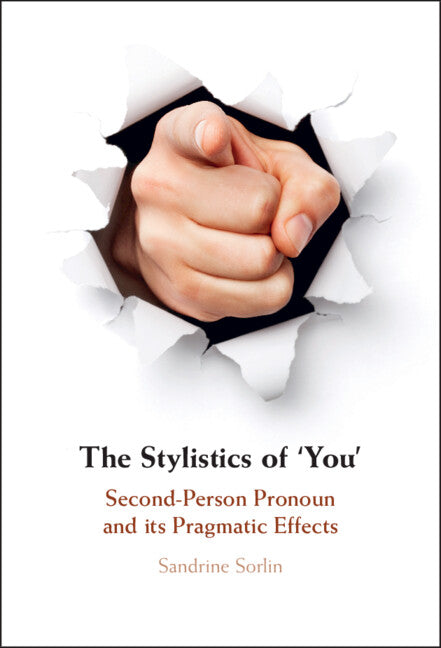
The Stylistics of ‘You'
Second-Person Pronoun and its Pragmatic Effects
Including examples from diverse sources, this book explores the pragmatic functions and effects of 'you' across time, genre and medium.
Sandrine Sorlin (Author)
9781108833028, Cambridge University Press
Hardback, published 13 January 2022
280 pages
23.6 x 15.8 x 2 cm, 0.55 kg
'Sorlin's rigorous mapping of uses of you in a wide-ranging corpus not only demonstrates the utility of her proposed model and its relevance for existing narratological frameworks and theories, but also for future interventions in diverse fields from autotheory, econarratology, trauma narratives to the recent turn against empathy in narrative studies.' Denise Wong, Diegesis
This book takes 'you', the reader, on board an interdisciplinary journey across genre, time and medium with the second-person pronoun. It offers a model of the various pragmatic functions and effects of 'you' according to different variables and linguistic parameters, cutting across a wide range of genres (ads, political slogans, tweets, news presentation, literary genres etc.), and bringing together print and digital texts under the same theoretical banner. Drawing on recent research into intersubjectivity in neuropsychology and socio-cognition, it delves into the relational and ethical processing at work in the reading of a second-person pronoun narrative. When 'you' takes on its more traditional deictic function of address, the author-reader channel can be opened in different ways, which is explored in examples taken from Fielding, Brontë, Orwell, Kincaid, Grimsley, Royle, Adichie, Bartlett, Auster, and even Spacey's 'creepy' 2018 YouTube video, ultimately foregrounding continuities and contrasts in the positioning of the audience.
1. Theorising the 'you effects'
Part I. Singularising and Sharing: the Dialectics of 'You': 2. George Orwell's Down and out in Paris and London (1933): Putting yourself in the shoes of a tramp
3. Paul Auster's ordinary life and yours: blendable singularities?
Part II. The Role of 'You' in the Writing of Traumatic Events: 4. Performing 'self-othering' in Winter Birds (1994) by Jim Grimsley
5. Pronominal 'veering' in Quilt (2010) by Nicholas Royle
Part III. The Author-Reader Channel across Time, Tender, Sex and Race: 6. Two ways of conversing with the reader
7. Empathy for sexual minorities in Skin Lane by Neil Bartlett (2007)
8. The ethics and politics of the second person in 'postcolonial' writing
Part IV. New Ways of Implicating through the Digital Medium?: 9. From paratext to hypertext: interactivity revisited
10. Coercing without edifying: Kevin Spacey's 2018 'Creepy' YouTube video explained
Conclusion
References
Index.
Subject Areas: Cognition & cognitive psychology [JMR], Semantics, discourse analysis, etc [CFG], Historical & comparative linguistics [CFF], Sociolinguistics [CFB]