Freshly Printed - allow 8 days lead
Couldn't load pickup availability
The Study of Change
Chemistry in China, 1840–1949
Describes the introduction and development of chemistry in China in the late 19th and early 20th century.
James Reardon-Anderson (Author)
9780521391504, Cambridge University Press
Hardback, published 22 February 1991
464 pages
23.8 x 16 x 3 cm, 0.77 kg
"No one in the West of in China has come close to Reardon-Anderson in giving such a comprehensive description of the history of modern science in China." William J. Haas, ISIS
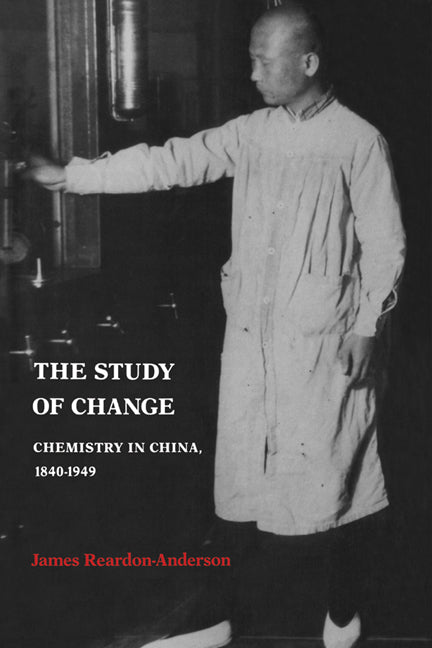
When Western missionaries introduced modern chemistry to China in the 1860s, they called this discipline hua-hsueh, literally, 'the study of change'. In this first full-length work on science in modern China, James Reardon-Anderson describes the introduction and development of chemistry in China in the late nineteenth and early twentieth centuries, and examines the impact of the science on language reform, education, industry, research, culture, society, and politics. Throughout the book, Professor Reardon-Anderson sets the advance of chemistry in the broader context of the development of science in China and the social and political changes of this era. His thesis is that science fared well at times when a balance was struck between political authority and free social development. Based on Chinese and English sources, the narrative moves from detailed descriptions of particular chemical processes and innovations to more general discussions of intellectual and social history, and provides a fascinating account of an important episode in the intellectual history of modern China.
Abbreviations
Preface
Introduction
Part I. Science and Self-Strengthening, 1840–1895: 1. The advocates: chemical translators, John Fryer and Hsü Shou
2. Changing Chinese: chemical translations of the Kiangnan Arsenal
3. The limits of change: science, state and society in the nineteenth century
Part II. The Interregnum, 1895–1927: 4. First-generation scientists: makers of China's new culture
5. Learning about science
6. The beginning of chemical research
7. Chinese entrepreneurs and the rise of the chemical industry
Part III. The Nanking Decade, 1927–1937: 8. Science and the state during the Nanking Decade
9. Scientific education: the balance achieved
10. Scientific research: the balance threatened
11. The chemical industry and the limits of growth
Part IV. The War, 1937–1945: 12. Science in nationalist China: the wartime experience
13. Science in communist China I: innovations in industry
14. Science in communist China II: scientists versus the state
15. Conclusion
Appendix
Glossary
Bibliography
Index.
Subject Areas: History of science [PDX]