Special Order - allow 2+ weeks lead
Couldn't load pickup availability
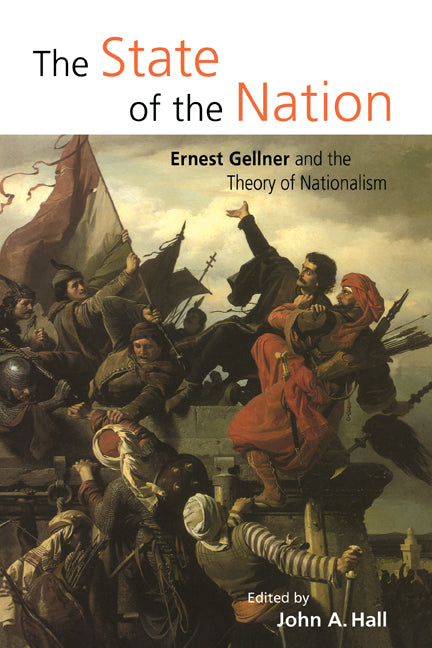
The State of the Nation
Ernest Gellner and the Theory of Nationalism
An exceptional set of scholars assess every aspect of the most influential theory of nationalism.
John A. Hall (Edited by)
9780521633246, Cambridge University Press
Hardback, published 26 November 1998
328 pages, 1 b/w illus. 2 tables
23.6 x 15.8 x 2.5 cm, 0.635 kg
"...Hall has done an excellent job in introducing the volume and dividing the articles into four sections that hold together rather well. John A. Hall has produced a book that contains much material that will be useful to economic historians both in terms of content, and more importantly, in methodology." Journal of Economic History
Nationalism is one of the major social and political issues of modern times, and a subject of intense intellectual debate. The most important and influential theory of nationalism is that of Ernest Gellner (1925–1995). This volume assesses every aspect of that theory, bringing together an exceptional set of scholars to explain, criticise and move beyond Gellner's work. In doing so the book establishes the state-of-play within the theory of nationalism, and complements Gellner's account by bringing political variables back into play. The book is unique in offering sustained attention to a single powerful theory, and will be of wide interest to students and scholars of political and social theory, history, sociology and anthropology.
Introduction John A. Hall
Part I. The Making of the Theory: 1. Thoughts about change: Ernest Gellner and the history of nationalism Roman Szporluk
2. Ernest Gellner's diagnoses of nationalism: a critical overview, or, what is living and what is dead in Ernest Gellner's philosophy of nationalism Brendan O'Leary
Part II. The Classical Criticisms: 3. Real and constructed: the nature of the nation Miroslav Hroch
4. The curse of rurality: limits of modernisation theory Tom Nairn
5. Nationalism and language: a post-Soviet perspective David Laitin
6. Ernest Gellner's theory of nationalism: some definitional and methodological issues Nicos Mouzelis
Part III. Bringing Politics Back In: 7. Nationalisms that bark and nationalisms that bite: Ernest Gellner and the substantiation of nations Mark Beissinger
8. Nationalism and modernity Charles Taylor
9. Modern multi-national democracies: transcending a Gellnerian oxymoron Alfred Stepan
Part IV. Wider Implications: 10. Nationalism and civil society in Central Europe: from Ruritania to the Carpathian Euroregion Chris Hann
11. From here to modernity: Ernest Gellner on nationalism and Islamic fundamentalism Dale F. Eickelman
12. Myths and misconceptions in the study of nationalism Rogers Brubaker.
Subject Areas: Nationalism [JPFN]