Freshly Printed - allow 7 days lead
Couldn't load pickup availability
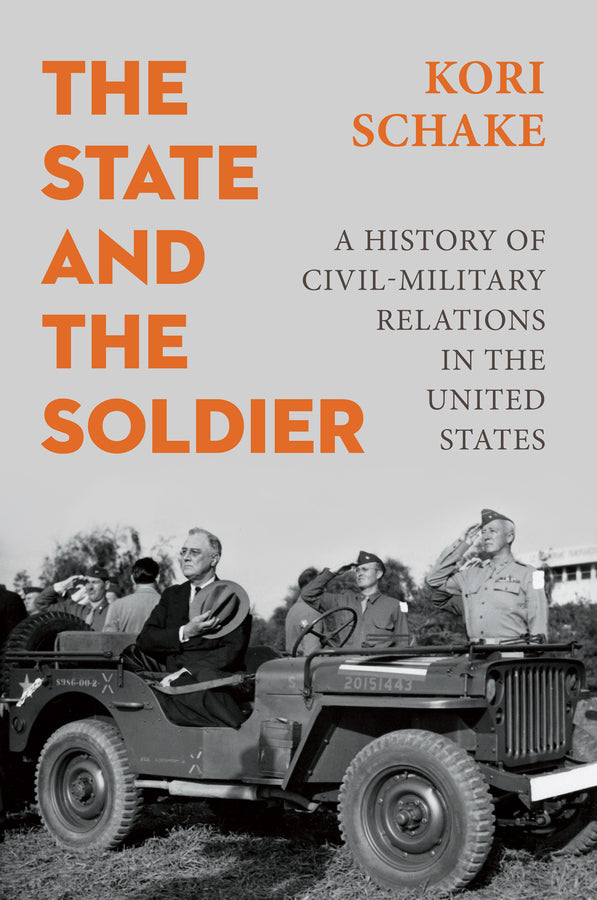
The State and the Soldier
A History of Civil-Military Relations in the United States
Kori Schake (Author)
9781509570539, Polity Press
Hardback, published 5 September 2025
272 pages
23.1 x 15.2 x 2.8 cm, 0.567 kg
"Both elected branches seem to have grown uninterested in making political and prudential arguments to the American people, and rely on both active-duty and retired officers to do it for them. Ms. Schake rightly warns that this practice undermines their long-term interest in political supremacy over the military."
Wall Street Journal
"It is the most important book on U.S. civil-military relations to appear in a generation and, at this moment, it deserves the broadest possible readership… a genuinely fresh intervention in a crowded field."
Foreign Policy
"Schake's superb historical overview demonstrates the resiliency of America's civil-military structure throughout the history of the republic. In that, there is hope for the future."
Claremont Review of Books
"It is rare that a history book is so timely. As Schake explains, we boast an enviable record of civil-military relations. If we want to keep that record, we need everyone – civilian leaders, military leaders, and the general public – to understand our history better and to apply the insights Schake draws out from her study."
Professor Peter Feaver
"Vivid, incisive, and rich with historical insights, Dr. Schake has constructed a profound, lens-changing assessment. This convincing analysis will stand the test of time as our primary guide to understanding and evaluating civil-military relations in America. A uniquely compelling piece of work."
General Jim Mattis, U.S. Marine (ret.) & 26th Secretary of Defense
America's Founding Fathers feared that a standing army would be a permanent political danger, yet the U.S. military has in the 250 years since become a bulwark of democracy. Kori Schake explains why in this compelling history of civil-military relations from independence to the challenges of the present.
The book begins with General Washington's vital foundational example of subordination to elected leaders during the Revolutionary War. Schake recounts numerous instances in the following century when charismatic military leaders tried to challenge political leaders and explains the emergence of restrictions on uses of the military for domestic law enforcement. She explores the crucial struggle between President Andrew Johnson and Congress after Lincoln's assassination, when Ulysses Grant had to choose whether to obey the Commander-in-Chief or the law – and chose to obey the law. And she shows how the professionalization of the military in the twentieth century inculcated norms of civilian control.
The U.S. military is historically anomalous for maintaining its strength and popularity while never becoming a threat to democracy. Schake concludes by asking if its admirable record can be sustained when the public is pulling the military into the political divisions of our time.
1 Introduction
2 Origin Story
3 Bad Examples
4 A Standing Army
5 Dogs That Mostly Didn't Bark
6 The Modern Military
7 How Worried Should We Be?
Epilogue: Disputing the Canon
Acknowledgments
Notes
Selected Bibliography
Index
Subject Areas: History [HB]