Freshly Printed - allow 7 days lead
Couldn't load pickup availability
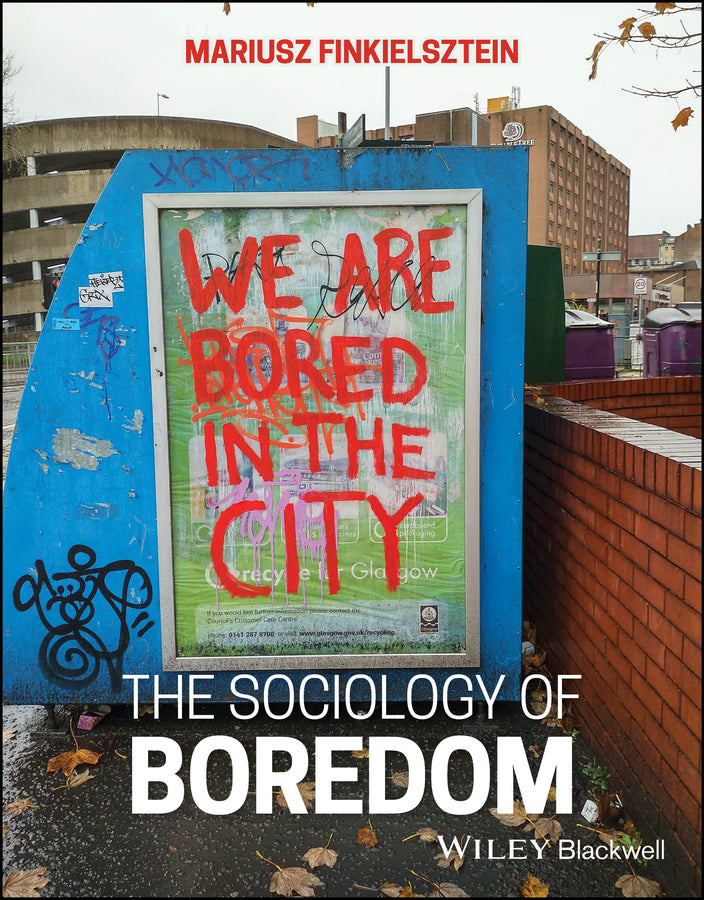
The Sociology of Boredom
Mariusz Finkielsztein (Author)
9781394253333, Wiley
Paperback / softback, published 17 April 2025
352 pages
27.2 x 21.6 x 2.5 cm, 0.794 kg
A pioneering sociological exploration of boredom as a culturally- and socially-dependent emotion Does boredom have a history? In The Sociology of Boredom, Mariusz Finkielsztein provides a new approach to conceptualizing, interpreting, and perceiving one of the most widespread, yet neglected, human emotions. Investigating boredom at both the macro- and micro-sociological level, Finkielsztein develops an original relational-expectational theory as he explores boredom through the lenses of different social structure theories, interactionist theory, historical sociology, sociology of emotions, essentialism and constructivism, and social anthropology. Eight in-depth chapters examine the social production of boredom in modernity and late modernity, addressing topics such as the boredom of marginalized groups, the concepts of busy boredom and consumer boredom, the characteristics and consequences of workplace boredom, the notion of smart boredom in the information society, and more. Containing detailed analyses of the nature of boredom and its connections to various spheres of social life, The Sociology of Boredom is essential reading for advanced undergraduates, postgraduates, university lecturers, and academic researchers in sociology and similar disciplines, particularly those involved in studies on emotions or boredom studies.
What can hunter-gatherers teach us about boredom?
Is boredom experienced differently by those in different socio-economic classes?
Is boredom a disease that is now globalized in a world of inequalities and marginalization?
Does boredom contribute to political movements, wars, terrorism, or cultural revolutions?
What does boredom have to do with power?
How do high expectations contribute to being recurrently bored?
Illustrations xi About the Author xii Acknowledgements xiii Introduction: Upstream Psychological Trend 1 In Search of the Sociology of Boredom 1 Boredom as a Social Emotion 4 Defining Boredom 5 The Structure of the Book 9 References 15 1 Boredom and Modernity 19 Does Boredom Have a History? 19 Hard Essentialism 20 Soft Essentialism: Philosophy 21 Soft Essentialism: Historicism 22 Boredom as a Social Construct of Modernity 29 Disenchantment of the World: Life Without a Mythology 32 Rationalization: The Supersedure of Meaning by Function 35 Industrialization 36 Alienation 37 Institutionalization of Boredom: Bureaucracy and Education 39 Individualism: The Atrophy of Community 42 Leisure Boredom 43 Romantic Boredom 43 Anomie and Boredom 45 References 50 2 Late Modern Boredom 57 Busy Boredom 58 Acceleration and the Achievement Society 58 Social Placebos and Smart Boredom 61 Overload: Redundancy, Noise, and Inattention 64 Consumer Boredom 68 Artificial Needs 72 The Addiction to Stimuli, Novelty, and Pleasure 74 Change for Change’s Sake: Fashion 77 The Boredom Industry and the Failure of Re- enchantment 79 The Rationalization of Consumption 80 Consumer Passivity 81 The Dream- driven Society of High Expectations 82 Boredom as a Fundamental Mood of Consumerism 83 References 85 3 Boredom and Social Inequality 90 Boredom as a Class Issue 90 Boredom of the Marginalized 96 On the Margins of the Society 97 Boredom in Refugee Camps: Anomic Boredom 99 Women’s Boredom: Between Privilege and Marginalization 104 Boredom and the Capitalistic World- system 109 Peripheral Boredom. 111 Indigenous Boredom 114 References. 117 4 Workplace Boredom 122 Work as a Boring Concept 122 Unnaturalness of Work 122 Boredom and Basic Income 128 The Concept of Workplace Boredom 131 Causes of Workplace Boredom 133 Direct Causes 133 Individual Characteristics 133 Task Characteristics 135 Person- job Fit 137 Work Environment 139 Systemic Causes 139 Managerialism: Rationalization and Bureaucratization 139 Secularization of Work: Lack of Calling 141 Identity Disturbance: Anomic Work- related Boredom 144 Precarious Employment: Lack of Belonging 146 Redundant Work: Bullshit Jobs 149 Commodification of Feelings: Emotional Labour 152 Boring Occupations 153 Outcomes of Workplace Boredom 155 Empty Labour 156 Boreout, Burnout, and Boredom 157 Counterproductive Work Behaviours as Workplace Boredom Coping Strategies 158 References 161 5 Religious Boredom 171 Boredom in the Sphere of Religion 171 Boredom as a Moral Issue 171 Boredom and Religion 173 Demagification and Secularization of Religion 174 Between Disenchantment and Re- enchantment 176 Acedia 178 Church Boredom 182 References 189 6 Boredom and Social Change 194 Boredom and Social (De)Mobilization 195 Political Boredom. 198 Boredom and Violence 200 Wars 200 Terrorism 202 Revolts and Revolutions 204 Relative Deprivation and Failure of Expectations 210 References 213 7 Boredom and Utopia 217 Literary Utopias 219 Why Utopias Are Inherently Boring 219 Prohibition of Boredom 224 Preventing Utopian Boredom 225 “Real” Utopias 227 References 231 8 Interactional Boredom 233 Interactionist Approach 233 Interaction Withdrawal 233 Role Distance 235 Interactional Ritual and Anticipatory Boredom 237 Low Emotional Energy 240 Boredom and Socialization 241 Conversational Boredom: Bores 243 Boredom and Power 248 Strategic Boredom: Boredom and Social Control 252 Boredom on Display 255 Romantic Relationship Boredom 257 References 261 Conclusion: The Relational-expectational Theory of Boredom 267 Premise 1: Boredom Is a Socially- constructed Emotion 268 Premise 2: Boredom Is a Relational State 268 Premise 3: Boredom Is Caused by a Failure of Expectations 269 Premise 4: Expectation- Driven Boredom Is a Civilizational Trait 271 Premise 5: Expectations (in the Form of Desires/Dreams/Aspirations) Make the Reality Boring 271 Premise 6: Expectation- driven Boredom Is a Function of Social Comparisons 274 Premise 7: Expectations May Lead to Anticipatory Boredom 275 Remedies 276 References 281 Further Reading 285 Index 318
Subject Areas: Sociology & anthropology [JH]