Freshly Printed - allow 10 days lead
Couldn't load pickup availability
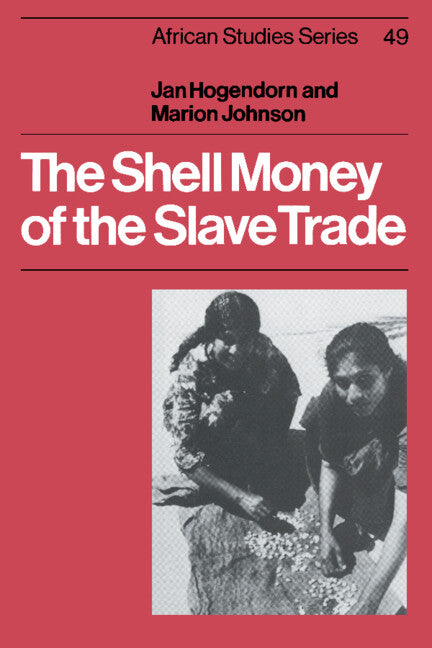
The Shell Money of the Slave Trade
A study of the role of cowrie-shell money in West African trade, particularly the slave trade.
Jan Hogendorn (Author), Marion Johnson (Author)
9780521541107, Cambridge University Press
Paperback / softback, published 18 September 2003
248 pages
22.9 x 15.3 x 1.7 cm, 0.39 kg
This study examines the role of cowrie-shell money in West African trade, particularly the slave trade. The shells were carried from the Maldives to the Mediterranean by Arab traders for further transport across the Sahara, and to Europe by competing Portuguese, Dutch, English and French traders for onward transport to the West African coast. In Africa they served to purchase the slaves exported to the New World, as well as other less sinister exports. Over a large part of West Africa they became the regular market currency, but were severely devalued by the importation of thousands of tons of the cheaper Zanzibar cowries. Colonial governments disliked cowries because of the inflation and encouraged their replacement by low-value coins. They disappeared almost totally, to re-appear during the depression of the 1930s, and have been found occasionally in the markets of remote frontier districts, avoiding exchange and currency control problems.
Maps
Tables and chart
Preface
Introduction
1. The cowrie
2. The Maldive Islands
3. The Portuguese domination
4. The Dutch and English enter the trade (seventeenth century)
5. Prosperity for the cowrie commerce (eighteenth century)
6. Boom and slump for the cowrie trade (nineteenth century)
7. Collection, transport and distribution
8. Cowries in Africa
9. The cowrie as money: transport costs, values and inflation
10. The last of the cowrie
Notes
Bibliography
Index.
Subject Areas: General & world history [HBG]