Freshly Printed - allow 7 days lead
Couldn't load pickup availability
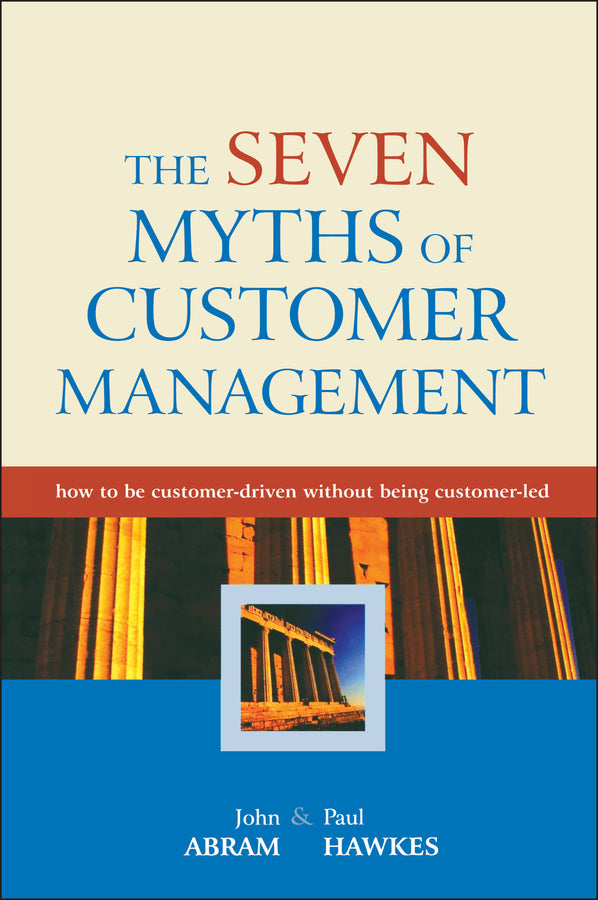
The Seven Myths of Customer Management
How to be Customer-Driven Without Being Customer-Led
John Abram (Author), Paul Hawkes (Author)
9780470858806, Wiley
Hardback, published 24 June 2003
236 pages
23.3 x 16 x 2 cm, 0.482 kg
"…is a stimulating canter through some marketing mantras, dismantling them fairly and frankly before suggesting alternatives…" (Marketing, 16 October 2003) “… iconoclastic…” (Admap, February 04) "...The myths put CRM into perspective, explaining what to use and what to discard." (Brand Strategy, September 2006)
Die Kunden - sie sind der größte Aktivposten eines Unternehmens und die Hauptquelle für langfristige Wertschöpfung in einem Unternehmen. Doch anders als andere Aktivposten, verändern sich die Kunden permanent. Deshalb muss man besonders sorgsam mit ihnen umgehen, wenn man die Erträge, die sie dem Unternehmen bescheren, maximieren will.
"The Seven Myths of Customer Management" sagt Ihnen, wie erfolgreiches Customer Management aussieht.
Die Autoren kritisieren, dass dem Thema Kundenzufriedenheit und der Vorrangstellung des Kunden eine viel zu große Bedeutung beigemessen wurde, und zwar auf Kosten kompromissloser Kommerzialisierung.
Die meisten Unternehmen hätten bei ihrer übertriebenen Kundenorientiertheit vergessen, dass die oberste Geschäftsregel heisst, Geld zu verdienen.
Dieses pragmatische Buch räumt auf mit dem weit verbreiteten "Der Kunde ist König"-Klischee und zerstört die sieben Mythen des Customer Management, wie z.B. 'Die Kundenbindung ist der Schlüssel zu erhöhter Rentabilität' oder 'Kundenzufriedenheit führt zu Kundentreue' oder aber 'Wiederholungskäufe sind dasselbe wie Kundentreue'.
Es stellt einen Aktionsplan auf, der Schritt-für-Schritt erklärt, wie man Kundenorientierung und kommerzielle Ziele miteinander in Einklang bringt.
Ziel des Buches ist es, dass Unternehmen lernen, kundenorientiert zu sein, aber nicht kundengesteuert.
Figures ix Acknowledgements xi Introduction xii 1 The seven myths of customer management: Debunking some established wisdom 1 The dangers of customer leadership 1 What is really happening? 5 Myth 1: Customer retention is the key to increased profitability 6 Myth 2: Divesting unprofitable customers will increase profitability overall 9 Myth 3: Customer satisfaction leads to customer loyalty 12 Myth 4: Repeat purchase is the same as customer loyalty 15 Myth 5: Organizations should develop relationships with their customers 18 Myth 6: One-to-one marketing is the ultimate goal 21 Myth 7: Technology is the primary enabler of customer focus 25 A different approach 28 2 Testing the water: Understanding where you are today 29 Picking up customer signals 32 Business-to-business customers 36 What research does not tell you 39 New technology, new danger 42 Substituting benchmarking for thought 44 Ten ways to gain real customer insight 46 3 Look before you leap: Developing a customer-focused strategy 50 What is customer-focused strategy? 52 Strategy in context 55 Developing customer-focused strategy 58 Appraising the world outside 62 Seeking to be different 66 Leading on cost 69 Focusing on markets or customers 70 The customer lifecycle 73 Deciding and evaluating alternatives 77 Action planning 80 4 Measuring your way to success: Allocating resources for maximum effect 83 The failure of measurement 85 Customer attitude measures 86 Customer retention measures 87 Customer value measures 89 The failure of management information systems 93 Towards customer value 97 Customer value analysis in action 102 The pitfalls and problems 107 The benefits of value-based management 109 5 Don’t keep it too simple, stupid: The need for a segmented approach 111 Segment or die 113 Understanding customers’ needs and motivations 114 Collecting the data 120 From data to intelligence 120 From intelligence to hypothesis 126 From hypothesis to appraisal 130 From appraisal to strategy 131 From strategy to results 133 Pitfalls and problems 136 Segmentation: a postscript 138 6 Lining up the ducks: Aligning the company for customer focus 140 Aligning finance 142 Aligning product strategy 143 Aligning the proposition: from product to profit 146 Brand alignment 148 Aligning distribution 150 Aligning customer communication 152 Loyalty programmes 158 Alignment: a postscript 163 7 Are you the problem? The role of leadership in creating customer focus 164 Data-less decision making 166 Rearranging the deckchairs 168 The pitfalls of project teams 169 Best practice is sometimes best left alone 170 Incentivizing inappropriate behaviour 172 Technology turmoil 175 Everyone embraces change enthusiastically 179 Reorganizing for focus 183 Changing a light bulb 187 8 Bringing the focus alive: A practical action plan 188 An action plan for customer focus 190 Managing the customer focus process 190 The internal review 193 Customer dynamics and needs 195 Segment objectives and propositions 198 Customer-management objectives, strategy and tactics 200 Channel strategies and implementation 207 Testing and performance measurement 208 Customer and market knowledge management 211 Change planning 213 Technology strategy 214 Index 218
Subject Areas: Business & management [KJ]