Freshly Printed - allow 8 days lead
Couldn't load pickup availability
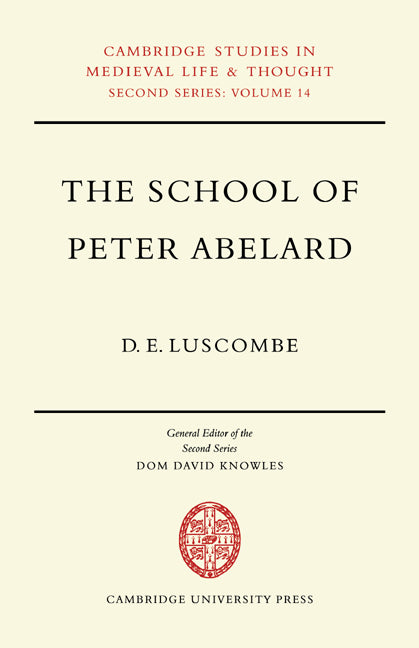
The School of Peter Abelard
The Influence of Abelard's Thought in the Early Scholastic Period
Dr Luscombe considers the influence of Abelard's principal teachings among his contemporaries and successors.
D. E. Luscombe (Author)
9780521088824, Cambridge University Press
Paperback / softback, published 30 October 2008
376 pages
21.6 x 14 x 2.1 cm, 0.48 kg
Peter Abelard conducted many analyses of Scriptural and Patristic teachings, and achieved an extensive rapprochement between Christian and pagan thought. His public career was ended in 1140 by an ecclesiastical condemnation, but this touched upon the central issues facing the early leaders of the medieval scholastic movement and Abelard's own teachings continued to be controversial. Dr Luscombe considers the influence of Abelard's principal teachings among his contemporaries and successors. his aim is to explain the conflicting estimates of Abelard which were current in the twelfth century and later, and to provide a full account of the writings and varied fortunes of Abelard's disciples. He also examines the manuscript tradition of Abelard's work and that of his followers. The condemnation of 1140 repudiated Abelard's leading doctrines. This led some of Abelard's disciples to partly retreat from the position of their master, whereas some chose to adapt and extend his teachings.
1. The Literary Evidence
2. Abelard's Followers
3. The Diffusion of Abelardian Writings
4. The Condemnation of 1140
5. The Theological Writings of Abelard's Closest Disciples
6. The School of Laon
7. Hugh of St Victor
8. The Summa Sententiarum
9. Abelard and the Decretum of Gratian
10. Abelard's Disciples and the School of St Victor
11. Peter Lombard
12. Robert of Melun
13. Richard of St Victor
14. Conclusion.
Subject Areas: Early history: c 500 to c 1450/1500 [HBLC], European history [HBJD]