Freshly Printed - allow 10 days lead
Couldn't load pickup availability
The Roman Provinces, 300 BCE–300 CE
Using Coins as Sources
Highly illustrated introduction to Roman provincial coins, opening up a huge range of contemporary evidence to students of ancient history.
Andrew Burnett (Author)
9781009420105, Cambridge University Press
Paperback / softback, published 14 November 2024
406 pages, 226 colour illus. 16 maps
21.6 x 14 x 2.1 cm, 0.561 kg
'This is the first volume in this series to have images in colour, which is a very welcome advance since it allows readers to better appreciate the different and changing metals of the coins. The result is an extremely useful book for students of both the Republican and imperial periods, offering clearly discussed numismatic data and connections to many key debates in Roman history including imperialism, the economy, the second sophistic, language, culture and the 'Romanisation' debate.' Clare Rowan, Bryn Mawr Classical Review
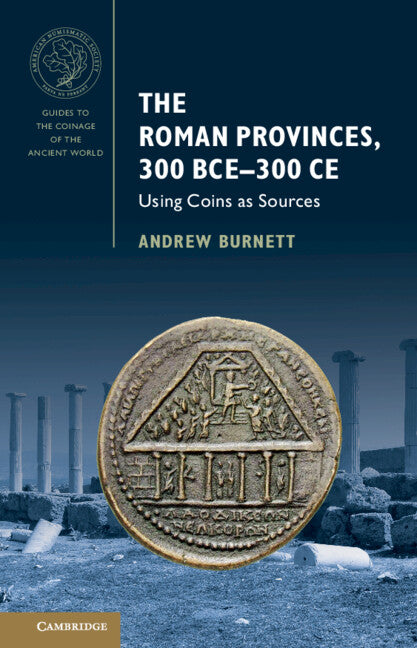
Provincial coinage gives us a unique insight into the Roman world, reflecting the values and concerns of the elites of the many hundreds of cities in the Roman empire. Coins offer a very different perspective from written history, which usually represents the views of the senatorial class, and which was usually composed long after the events that are described. The coins, in contrast, provide evidence without hindsight, and uniquely allow a systematic examination across the whole Roman world. This volume makes it possible for instructors and students and scholars to deploy a complex set of material evidence on many historical topics. It includes over two hundred illustrations of coins with detailed captions, so providing a convenient sourcebook of the most important items, and covers topics such as the motivation for Roman conquest, the revolution of Augustus, the world of the Second Sophistic and the crisis of the third century.
1. Precious metal coinages at Rome and in the provinces
2. The beginnings of an empire in Italy and the western Mediterranean (300–200 BCE)
3. The growth of an empire during the late Republic (200–31 BCE)
4. Whose coins? A model for city coinage in imperial times
5. The revolution of Augustus – and becoming more Roman in the first century CE
6. Reinforcing Greek identity in the Golden Age of the second century CE
7. 'From a kingdom of gold to one of iron and rust' in the third century CE.
Subject Areas: Ancient history: to c 500 CE [HBLA]