Freshly Printed - allow 7 days lead
Couldn't load pickup availability
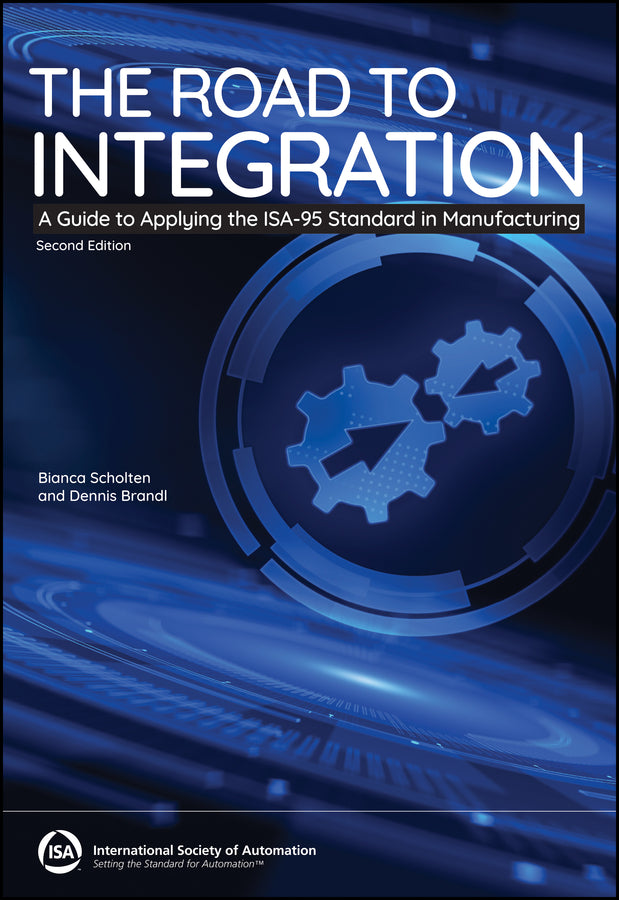
The Road to Integration
A Guide to Applying the ISA-95 Standards in Manufacturing
Bianca Scholten (Author), Dennis L. Brandl (Author)
9781643311463, Wiley
Paperback / softback, published 31 January 2023
224 pages
25.4 x 17.8 x 1.3 cm, 0.517 kg
The Road to Integration: A Guide to Applying the ISA-95 Standards in Manufacturing, 2nd Edition To run efficiently and cost effectively as well as produce quality products, manufacturing control systems on the plant floor must be able to communicate with the enterprise systems. Materials must be purchased and delivered on time, personnel must be scheduled, equipment must be available and operating properly, recipes must be precise, processes must be tracked, and product quality must be monitored so that changes can be made—all in real time. The problem is this: each system in the process speaks a different language. The ISA-95 Enterprise Control System Integration series of standards is a guide for creating the interfaces needed to bridge the language gap. It provides consistent terminology for the phases and steps throughout the supply and manufacturing processes and models for implementing the interfaces. The Road to Integration, Second Edition, explains how to use the principles, terminology, and information methods in the standard to integrate enterprise resource planning (ERP) systems, manufacturing execution systems (MES), and manufacturing operations management (MOM) systems. It provides examples and step-by-step plans for integration projects as well as case studies describing the implementation methods used by companies in different industries. Specific topics include: The authors discuss ISA-95 in the broader context of modern information exchange technologies and offer a complete picture for project managers, consultants, programmers, and information architects who want to integrate ERP and MOM/MES systems based on the international standard.
List of Figures xi Chapter 1 Getting Acquainted with ISA-95 1 Chapter 2 Applying ISA-95 as an Analysis Tool 49 Chapter 3 Understanding and Applying the ISA-95 Object Models 99 Chapter 4 Chapter Integration Using ISA-95 139 Frequently Asked Questions 171
Photo and Artwork Credits xiii
Foreword xv
Preface xix
About the Authors xxi
Introduction xxiii
1.1 Introduction 2
1.2 History of the Development of ISA-95 2
1.3 Objective and Content of ISA-95 4
1.4 Applying ISA-95 37
1.5 Advantages of Applying ISA-95 41
1.6 The Future of (and with) ISA-95 42
1.7 Summary 46
2.1 Introduction 50
2.2 Why Perform an ISA-95 Analysis? 50
2.3 The Steps in an ISA-95 Analysis 52
2.4 Preparation and Methodology 53
2.5 Getting Down to Work 62
2.6 Writing the Conclusion and Recommendations 81
2.7 Points of Concern in an ISA-95 Analysis 84
2.8 End Users' Experiences with ISA-95 Analyses 93
2.9 Summary 96
3.1 Introduction 100
3.2 Object Models: The How and Why 101
3.3 General Description of the Object Models 103
3.4 Example: WeMadeIt Furniture 108
3.5 The Resource Models 109
3.6 Operations Schedules, Performance, Capabilities, and Definitions 117
3.7 Work Schedules, Performance, Capabilities, and Definitions 126
3.8 Other Models 133
3.9 Case Study 133
3.10 Summary 137
4.1 Introduction 140
4.2 Industrial Integration Models 141
4.3 The ISA-95 Integration Architecture 146
4.4 Step-by-Step Integration Project Plan 154
4.5 Points of Concern 162
4.6 Summary 168
Glossary 173
Bibliography 179
Index 181
Subject Areas: Mechanical engineering & materials [TG]