Freshly Printed - allow 10 days lead
Couldn't load pickup availability
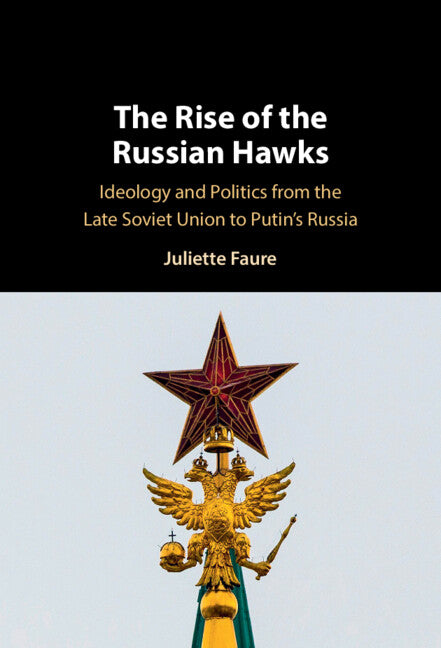
The Rise of the Russian Hawks
Ideology and Politics from the Late Soviet Union to Putin's Russia
Studies the evolution of the interplay between ideology and politics in Russian governance from the former USSR to contemporary times.
Juliette Faure (Author)
9781009542685, Cambridge University Press
Hardback, published 29 May 2025
386 pages
22.9 x 15.2 x 2.2 cm, 0.737 kg
'The hopes that Russia would turn to the West after the end of the Cold War proved illusory. Juliette Faure's The Rise of the Russian Hawks offers a rich blend of historical research, sociology of ideas and discourses, and the interaction of networks and ruling elites to illuminate the ideological sources of the Russian divergence. With extensive textual analysis and in person interviews, she illuminates the world of 'modernist' and 'dynamic' conservatism from the Soviet era to Russian aggression against Ukraine. Drawing on hypotheses about reactionary modernism and the integration of elements of modernity with cultural conservatism, Faure explores two generations of Russian intellectuals who managed to combine skilful discourse, effective networks, and access to political power to fashion what she calls the 'hegemonic discourse' in Putin's Russia. The result is a work of contemporary intellectual history and social science analysis that should be of great interest to her fellow scholars, policy analysts and policy makers, and concerned citizens.' Jeffrey Herf, Distinguished University Professor, Emeritus, Department of History, University of Maryland, College Park
Studying the interplay between ideology and politics in Russian governance, from the former USSR to contemporary Russia, this book examines why, despite the prohibition of state ideology in the 1993 Russian Constitution, Russian hawks endured beyond the 1991 regime change and have risen to political prominence as the chief ideologues of Russia's confrontation against the West. Departing from realist and constructivist explanations of foreign policy focused on Vladimir Putin, Juliette Faure highlights the influence of elite groups with diverse strategic cultures and reveals how, even under authoritarian rule, a competitive space exists where rival elites contest their visions of national interests. Demonstrating the regime's strategic use of ideological ambiguity to maintain policy flexibility, Faure offers a fresh lens on the domestic factors that have played into the Russian regime's decision to wage war against Ukraine and their implications for international security, regional stability and the global balance of power.
1. Introduction
2. Re-enchanting Soviet modernity (1960–85)
3. The emergence of the Russian hawks as an idea network (1985–99)
4. From fringe to mainstream: Mister Hexogen's controversy (2001–2)
5. The rise of next-generation hawks in the 2000s
6. Inside the regime's market for ideology (2005–12)
7. Competing for Russia's grand strategy (2012–22)
8. Shaping Russia's wartime ideology (2022–24)
9. Conclusion
Annex 1: List of interviews
Annex 2: Professional occupation and network connections of the Izborskii Klub's founding members (2012–2013)
Annex 3: Professional occupation and biographical details of the Izborskii Klub members added in the period 20132021
References.
Subject Areas: Constitution: government & the state [JPHC]