Special Order - allow 2+ weeks lead
Couldn't load pickup availability
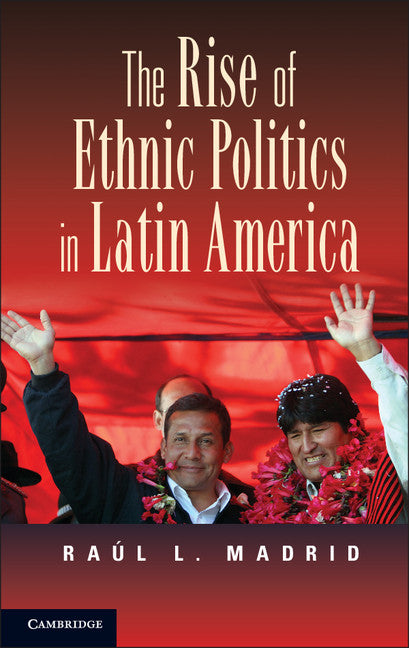
The Rise of Ethnic Politics in Latin America
Explores why indigenous movements have recently won elections for the first time in the history of Latin America.
Raúl L. Madrid (Author)
9780521153256, Cambridge University Press
Paperback / softback, published 30 March 2012
256 pages, 12 b/w illus. 7 tables
23.4 x 15.5 x 1.5 cm, 0.36 kg
'The Rise of Ethnic Politics in Latin America makes a major contribution to the study of ethnic politics. Madrid reconceptualizes ethnic mobilization in a way that takes seriously the mixed and fluid character of ethnic identities in Latin America, and he shows that ethnic parties only succeed in the region when they make inclusive appeals that go beyond ethnicity. Moreover, the book offers the most sophisticated analysis I have seen of the impact of ethno-populist movements on democracy in Latin America. Madrid's book helps us understand the distinct character of ethnic politics in Latin America, but I suspect it will travel beyond Latin America. I recommend it not only to students of Latin American politics, but to anyone interested in ethnic politics.' Steven Levitsky, Harvard University
The Rise of Ethnic Politics in Latin America explores why indigenous movements have recently won elections for the first time in the history of the region. Raúl L. Madrid argues that some indigenous parties have won by using inclusive populist appeals to reach out to whites and mestizos. Indigenous parties have managed to win support across ethnic lines because the long history of racial mixing in Latin America blurred ethnic boundaries and reduced ethnic polarization. The appeals of the indigenous parties have especially resonated in the Andean countries because of widespread disenchantment with the region's traditional parties. The book contains up-to-date qualitative and quantitative analyses of parties in seven countries, including detailed case studies of Bolivia, Ecuador and Peru.
1. Introduction
2. Ethnicity and ethnopopulism in Latin America
3. The ascent of the Movimiento al Socialismo in Bolivia
4. The rise and decline of Pachakutik in Ecuador
5. Ethnopopulism without indigenous parties in Peru
6. The failure of indigenous parties outside of the Central Andes
7. Indigenous parties and democracy in the Andes
Conclusion: 8. Theoretical implications.
Subject Areas: Comparative politics [JPB], Hispanic & Latino studies [JFSL4]