Freshly Printed - allow 7 days lead
Couldn't load pickup availability
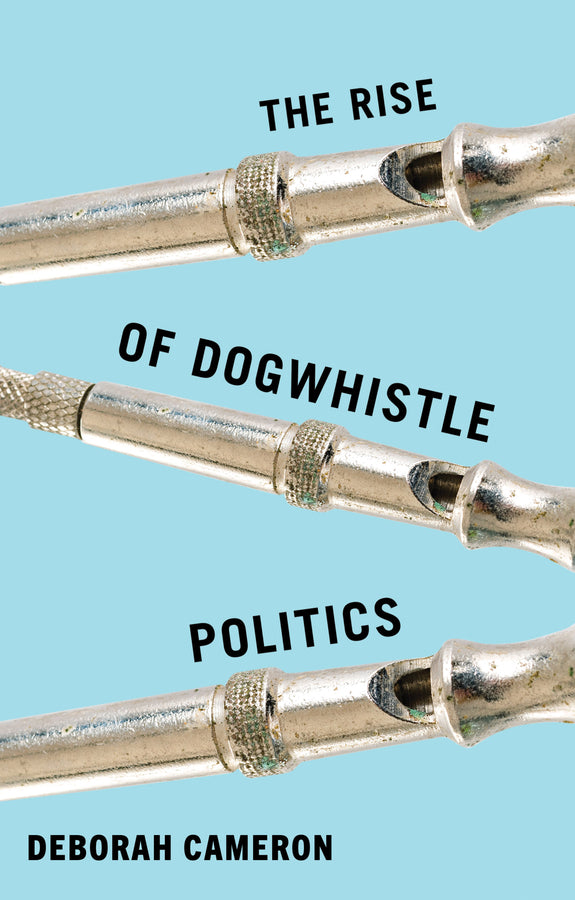
The Rise of Dogwhistle Politics
Deborah Cameron (Author)
9781509569007, Polity Press
Hardback, published 21 November 2025
192 pages
21.8 x 13.7 x 2.5 cm, 0.363 kg
"There's no one I would rather read on the politics of language than Deborah Cameron. Her work is always sharp, funny and insightful."
Helen Lewis, author of The Genius Myth
"In this engaging and accessible analysis, Deborah Cameron argues that political critique increasingly focuses on policing speech. The book is packed with real-life stories from British and American politics and activism on both left and right - all are subjected to insightful scrutiny. Cameron makes a powerful case for welcoming dissent, recognising nuance, and seeing language as a resource rather than a weapon."
Clare Chambers, author of Intact
"Cameron highlights how hurling around the dogwhistle charge has far-reaching consequences for public debate."
Joe Humprey, The Irish Times
The term dogwhistle, meaning a political message with a hidden or coded meaning, only entered mainstream usage in the mid-1990s, but today it seems to be everywhere. Accusations of dogwhistling fly in every political direction, and the meaning of the term has broadened to encompass an ever-expanding range of words, images, actions and objects.
This book investigates the rise of the dogwhistle as a key cultural and political reference point, arguing that it's a sign of our political times. It's related both to the polarized nature of politics in the era of populism, culture wars and online echo chambers, and to the preoccupation of radical activists on both sides of the traditional left/right divide with controlling language as a way of remaking culture. Their political aims are different, but their tactics are more similar than they might appear.
As well as examining how these tactics have recently been used, and looking at the arguments they now regularly prompt in public settings from social media to courts of law, this book by linguist Deborah Cameron considers some of the theoretical questions they raise about the way communication works and the effects it is capable of producing. It asks why contemporary radical movements put so much emphasis on words and symbols, and whether their faith in the power of language is justified.
1. The rise of dogwhistle politics
2. Understanding dogwhistles
3. Dogwhistles everywhere: how the concept has evolved
3. "An offence to be offensive": dogwhistle politics and the policing of speech
5. "Literal violence"? Dogwhistle politics and the language of harm
6. #LanguageMatters
Acknowledgements
Notes
Subject Areas: Politics & government [JP]