
Freshly Printed - allow 7 days lead
Couldn't load pickup availability
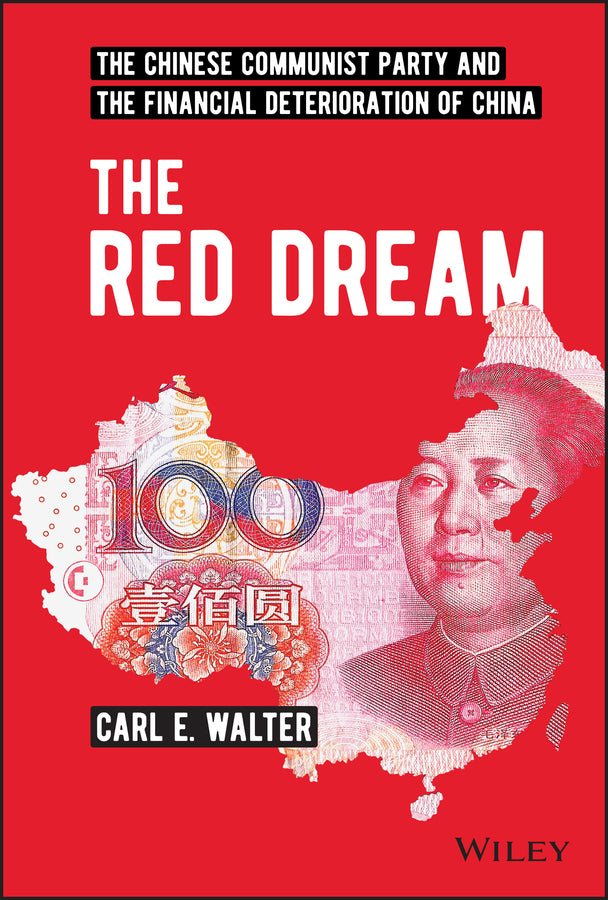
The Red Dream
The Chinese Communist Party and the Financial Deterioration of China
Carl E. Walter (Author)
9781119896159, Wiley
Hardback, published 8 September 2022
288 pages
23.1 x 15.2 x 2.3 cm, 0.499 kg
An eye-opening deep dive into the sources and consequences of how China has financed it’s rise to global economic prominence In The Red Dream: The Chinese Communist Party and the Financial Deterioration of China, veteran finance executive Carl Walter uses his unique experience in Chinese finance to deepen his exploration of how the Chinese Communist Party finances its obsession with GDP growth and social control. Overwhelmingly debt-fueled, the party’s financial strategy has driven an unsustainable growth in banking and state enterprise assets. Inevitably the party’s own financial health is being severely weakened and China’s future over the next decades put in doubt. You’ll also find: An essential read for anyone interested in international economics, geopolitics, and finance, The Read Dream will also earn a place in the hands of finance professionals, bankers, policymakers, corporate strategists, and investors.
Preface xi List of Abbreviations xix Chapter 1: From Turning Point to Turning Point 1 An Abrupt About-Face 2 The Golden Age: A Short Story 4 Underlying Conditions 7 The Yin and the Yang of the China Dream 10 Convergence 20 Chapter 2: The Shadow Fiscal System 23 China’s “Centralized” State and Localized Financing 24 Aspirational Central Finances, Fiscal Collapse and the 1994 Budget Law 29 The Continual Local Scramble for Funds 35 Then There Was the Land but It Is Not Free, 1999–2007 38 Paving the Country Over 45 The Vulnerability of Local Governments, Banks, and Enterprises 46 Implications 48 Chapter 3: China’s Banks and the Deposit Bonanza 57 China’s State Banks and the “Tree” Model of Banking 58 Command Lending and Funding 66 Fintech and Other Challenges to Bank Deposits 72 Bank Capitalization 80 Implications 83 Chapter 4: Trees Can Grow to Heaven! 87 Evolution of Chinese Balance Sheet Management Techniques 88 Outcomes in Financial Engineering Chinese-Style 91 Channels to Support State Bank Performance Metrics 93 Implications 115 Chapter 5: Beautifying Bank Balance Sheets 119 Parking Assets— the Interbank Market and “Repos” 120 Flexible Loan Agreements 124 Local Government Bonds 127 Government “Guidance” Funds 137 Off-Balance-Sheet Items 138 Comments 146 Chapter 6: After 30 Years, Was Deng Xiaoping Right? 151 A Summary State Balance Sheet 152 Inefficient Investment Equals Extrabudgetary Funding 154 The Promise of the Stock Markets 156 Massive Growth in Deposits 164 “Opening” the Door to Foreign Investment 166 Excessive Reliance on Debt 168 Deterioration of State Finances 169 Summing Up 173 So Was Deng Right, Can Capital Markets Be Used in a Socialist Economy? 178 Chapter 7: China versus the United States: Comparing the Costs of Financial Crises 183 Summary Financial Crises, China and the United States 184 Comparisons of Crises 189 Macro Comparisons and the Role of Central Banks 203 Comparisons of State Net Worth 206 Comments 208 Chapter 8: Japanese Bubbles 211 Bubbles and Japan’s Banking Crisis of the 1990s 212 Why Did Resolving Japan’s Banking Crisis Take So Long? 215 More Points of Comparison, China versus Japan 218 Comparative Cashflow Chains 222 How Might the Party Change Its Spots? 223 The Value of Chinese State Industrial Enterprise Assets 226 Comments 232 Chapter 9: Chinese Balloons 235 The Party’s Ruling Paradigm 238 Chinese Balloons 239 Convergence Revisited 241 Appendices 245 Selected Bibliography 251 Index 257
Subject Areas: Economics [KC]