Special Order - allow 2+ weeks lead
Couldn't load pickup availability
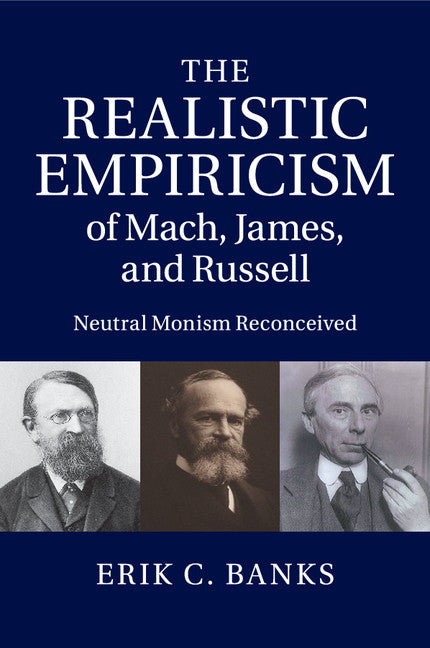
The Realistic Empiricism of Mach, James, and Russell
Neutral Monism Reconceived
This book redevelops an important movement in philosophy for the first time, exploring the ways in which three of the greatest thinkers are connected.
Erik C. Banks (Author)
9781107423763, Cambridge University Press
Paperback / softback, published 15 September 2016
226 pages, 17 b/w illus.
22.8 x 15.2 x 1.3 cm, 0.34 kg
In the early twentieth century, Ernst Mach, William James, and Bertrand Russell founded a philosophical and scientific movement known as 'neutral monism', based on the view that minds and physical objects are constructed out of elements or events which are neither mental nor physical, but neutral between the two. This movement offers a unified scientific outlook which includes sensations in human experience and events in the world of physics under one roof. In this book Erik C. Banks discusses this important movement as a whole for the first time. He explores the ways in which the three philosophers can be connected, and applies their ideas to contemporary problems in the philosophy of mind and the philosophy of science - in particular the relation of sensations to brain processes, and the problem of constructing extended bodies in space and time from particular events and causal relations.
Introduction. An overview of realistic empiricism
1. Mach: physical elements
2. Mach: philosophy of psychology
3. William James' direct realism: a reconstruction
4. Russell's neutral monism: 1919–27
5. Enhanced physicalism
6. The problem of extension: a constructivist program
Appendix. An outline of realistic empiricism.
Subject Areas: History of engineering & technology [TBX], History of science [PDX], Philosophy of mind [HPM], Philosophy of language [CFA]