Freshly Printed - allow 8 days lead
Couldn't load pickup availability
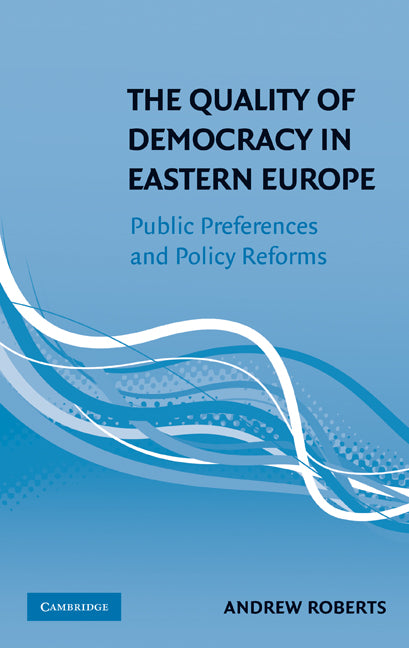
The Quality of Democracy in Eastern Europe
Public Preferences and Policy Reforms
This book presents a positive assessment of democratic quality as it has developed in ten postcommunist countries.
Andrew Roberts (Author)
9780521110334, Cambridge University Press
Hardback, published 12 October 2009
252 pages, 13 b/w illus. 17 tables
23.1 x 16 x 2.3 cm, 0.54 kg
“In this outstanding and timely book, Roberts makes a groundbreaking contribution: He brings conceptual clarity and methodological rigor to the study of the quality of democracy. For Roberts, linkages between citizens and policy-makers determine democratic quality; he shows us how to measure these linkages using quantitative and qualitative methods. In the East European cases this yields an important result: these new democracies are relatively robust.”
– Milada Anna Vachudova, University of North Carolina at Chapel Hill
How does democracy work in the new democracies of Eastern Europe? Do the people actually rule as one would expect in a democracy or do the legacies of communism and the constraints of the transition weaken popular control? This book presents a framework for conceptualizing and measuring democratic quality and applies this framework to multiple countries and policy areas in the region. It defines democratic quality as the degree to which citizens are able to hold leaders accountable for their performance and keep policy close to their preferences. Its surprising conclusion, drawn from large-N statistical analyses and small-N case studies, is that citizens exercise considerable control over their rulers in Eastern European democracies. Despite facing difficult economic circumstances and an unfavorable inheritance from communism, these countries rapidly constructed relatively high-quality democracies.
Preface
1. Introduction
Part I. Conceptual Analysis: 2. Assessing the quality of democracy
Part II. Statistical Analysis: Introduction to the Statistical Analyses: 3. Electoral accountability
4. Mandate responsiveness
5. Policy responsiveness
Part III. Case Study Analysis: Introduction to the Case Studies: 6. The politics of pension reforms
7. The politics of housing reforms
Part IV. Implications: 8. Explaining democratic quality
9. Conclusions
Bibliography.
Subject Areas: Comparative politics [JPB], Politics & government [JP]