Freshly Printed - allow 8 days lead
Couldn't load pickup availability
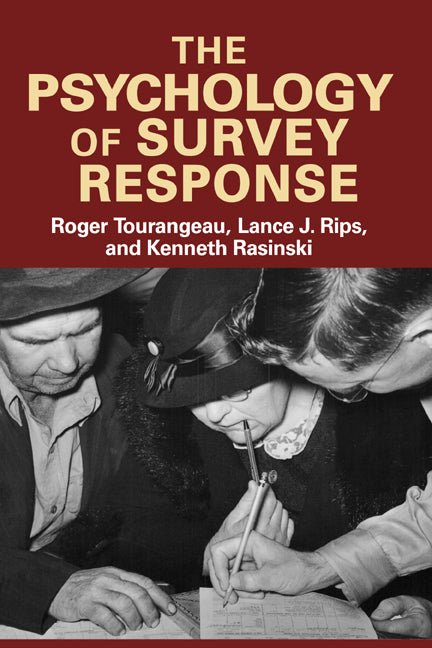
The Psychology of Survey Response
Examines the complex psychological processes involved in answering different types of survey questions.
Roger Tourangeau (Author), Lance J. Rips (Author), Kenneth Rasinski (Author)
9780521576291, Cambridge University Press
Paperback, published 13 March 2000
416 pages, 14 b/w illus. 40 tables
22.8 x 15.4 x 2.7 cm, 0.56 kg
"This is the best and most comprehensive book in the growing literature on the psychology of survey responding. It includes useful summaries of the behavioral science, often providing better exposition than the primary sources, and it draws clear, useful implications for practice. It is a landmark example of the application of scientific theory and laboratory findings to real life problems." Reid Hastie, University of Colorado at Boulder
This valuable book examines the complex psychological processes involved in answering different types of survey questions. Drawing on both classic and modern research from cognitive psychology, social psychology, and survey methodology, the authors examine how survey responses are formulated and they demonstrate how seemingly unimportant features of the survey can affect the answers obtained. The book provides a comprehensive review of the sources of response errors in surveys, and it offers a coherent theory of the relation between the underlying views of the public and the results of public opinion polls. Topics include the comprehension of survey questions, the recall of relevant facts and beliefs, estimation and inferential processes people use to answer survey questions, the sources of the apparent instability of public opinion, the difficulties in getting responses into the required format, and the distortions introduced into surveys by deliberate misreporting.
1. Introduction
2. Respondents' understanding of survey questions
3. The role of memory in survey responding
4. Answering questions about date and durations
5. Attitude questions
6. Factual judgments and numerical estimates
7. Attitude judgments and context effects
8. Mapping and formatting
9. Survey reporting of sensitive topics
10. Mode of data collection
11. Impact of the application of cognitive models to survey measurement.
Subject Areas: Social, group or collective psychology [JMH]