Freshly Printed - allow 7 days lead
Couldn't load pickup availability
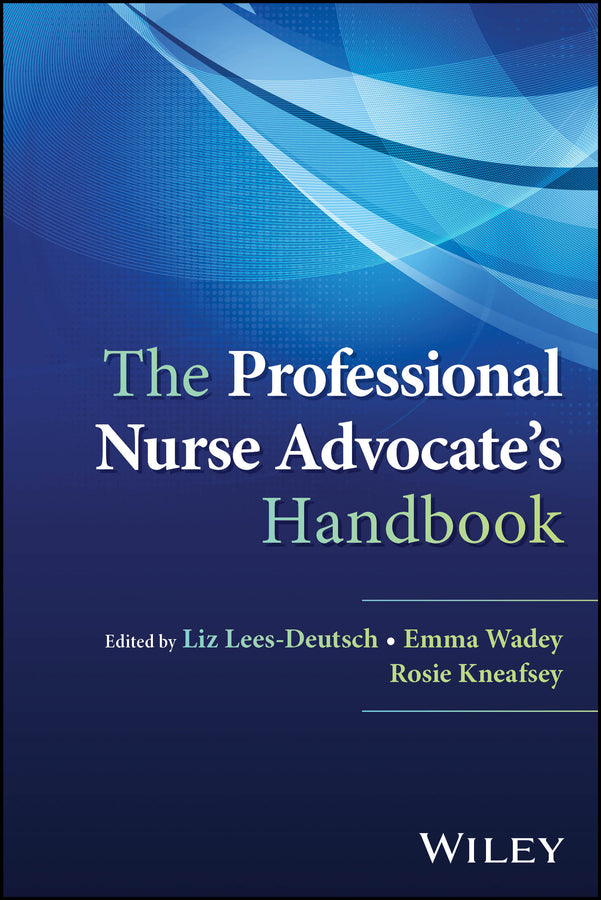
The Professional Nurse Advocate's Handbook
Liz Lees-Deutsch (Edited by), L Lees–Deutsch (Author), Emma Wadey (Edited by), Rosie Kneafsey (Edited by)
9781394308071, Wiley
Paperback / softback, published 9 July 2026
224 pages
22.9 x 15.3 x 1.5 cm, 0.68 kg
Detailed handbook on the vital role of Professional Nurse Advocate The Professional Nurse Advocate’s Handbook is the first book to bring together a diverse range of voices and ideas that illustrate how the Professional Nurse Advocate (PNA) role is being applied across different settings. Across eight chapters, this book weaves together short case studies from practice with broader reflections on the origins and purpose of the PNA role. Written by a team of highly qualified authors working in practice, The Professional Nurse Advocate’s Handbook discusses: An essential read for current and aspiring PNAs, The Professional Nurse Advocate’s Handbook also provides a valuable resource for those involved in nursing education and practice looking for strategies to sustain the wellbeing of the nursing workforce and shape a compassionate culture within healthcare.
About the Editors x Notes on Contributors xii Foreword xv List of Abbreviations xvii Keywords xviii Acknowledgement for PNA Handbook xix Chapter 1 Introducing PNA and PMA Developments 1 Introduction 1 The Creation and Development of the Professional Midwifery Advocate Role 2 Training to Become a Professional Midwifery Advocate 3 Supporting Implementation of The PMA Role and Service 3 The Academic PMA 6 The Creation and Development of the Professional Nurse Advocate Role 9 Training to Become a Professional Nurse Advocate 10 Supporting Implementation of The PNA Role and Service 11 The PNA Role in Practice 13 Impact of PNA 14 Summary 17 References 18 Chapter 2 Nurse Identity, Global Belonging and the Professional Nurse Advocate Role 20 Concepts of Global Nurse Identity 21 A Sense of Belonging in Nursing 22 The Global Workforce 23 Internationally Educated Nurses 24 The Nursing Workforce in the United Kingdom 25 Strategies to Support Nurse Identity and Belonging 26 Support for Internationally Educated Nurses 27 Newly Qualified Nurses 28 The Professional Nurse Advocate Role 29 Professional Identity and Empowerment 30 Nurse Well- being 30 Impact on PNA Supervisor 30 Implications for Health and Policy 30 Conclusion 31 References 31 Chapter 3 Leadership Models and the PNA Role 39 Historical Context 39 Nursing, Management and Leadership Theories 40 Trait Theory and PNA Role 41 Bureaucracy, Management and Leadership Theories 44 Contingency Theories 47 Leadership Styles 47 Transactional and Transformational Leadership Styles 48 Adair ‘Action – Centred’ Leadership 50 Human Relations Management 51 Leadership Theories to Form Organisational Culture 53 New Leadership 53 Authentic, Ethical and Value- Based Leadership 55 Systems and Global Leadership 57 Conclusion 58 Tips for PNA Practice 58 Acknowledgement 60 References 60 Chapter 4 A- EQUIP – Exploring the Normative Aspects of the Model (Education and Development) 64 A- EQUIP Model Education and Development 64 The Normative Function of the A-EQUIP Model: Monitoring, Evaluation and Quality Improvement 68 The Formative Function of the A- EQUIP Model: Educational and Development 69 The Restorative Function of the A- EQUIP Model: Restorative Clinical Supervision 69 Personal Action for Quality Improvement Function of the A- EQUIP Model 75 The Qualities Required by a PNA to Deploy the A- EQUIP Model 79 References 87 Chapter 5 Developing Restorative Supervision in the PNA Role 89 Introduction 89 How to Use this Chapter 89 Background and Context 90 Brief History of Clinical Supervision in Nursing 91 Move to a Restorative Model of Supervision 92 Role of Professional Nurse Advocates 93 Understanding Emotions 94 Brain Structures and Emotional Response 95 Emotional Labour in Nursing 97 The Supervisor in Restorative Clinical Supervision 98 Emotional Intelligence 100 Leadership 101 Active Listening 102 The Supervisee in Restorative Clinical Supervision 103 What to Expect from RCS 103 Structuring RCS 105 Group Supervision 106 1:1 Supervision 110 Asynchronous and Synchronous Supervision 111 RCS Structure 112 Types of RCS Conversations 114 Building Your Network and Support 129 References 131 Chapter 6 A Reflective Journey Through Quality Improvement for PNAs 137 Introduction: Quality Improvement for Professional Nurse Advocates 137 Learning the Language 138 The Purists and the Pirate 139 Stakeholders 139 The PDSA Cycle 140 The Drivers and the Hinders 146 Tips for Supporting Others to Run a QI Project 149 Personal Reflection 150 Conclusion 150 Glossary of Terms 151 References 151 Chapter 7 Communities of Practice to Support Well- being 153 Introduction 153 What is a Community of Practice (CoP)? 154 Examples of Communities of Practice 154 Benefits of Communities of Practice in Health Care 156 Setting Up and Sustaining Communities of Practice 158 Starting a CoP in Nursing or Midwifery 158 Virtual and In- Person CoPs 159 Time and Resource Constraints 159 Navigating Hierarchies and Power Dynamics 160 Global CoPs 162 Conclusion 162 References 163 Chapter 8 Cultivating Compassion Within Professional Nursing and Midwifery Advocacy 165 Introduction 165 Compassionate Cultures 166 Autonomy 167 Authority, Empowerment and Influence 167 Justice and Fairness 167 Work Conditions and Working Schedules 168 Belonging 169 Teamworking 169 Culture and Leadership 169 Contribution 170 Workload 170 Management and Supervision 171 Education, Learning and Development 171 Changing Culture 172 Laschinger’s Empowerment Theory 172 Compassionate Leadership 174 Attending – Actively Listen and Highlight Key Challenges 174 Empathising – Framing ‘Failures’ or Challenges as an Opportunity for Learning and Growth 175 Understanding – Engaged and Supportive Rather Than Directive 175 Helping – Reframing, Highlighting Resources, Removing Obstacles or Empowering Nurses and Midwives to Do So 176 Anti- Racism Practice 177 Well- Being and Self- Compassion 177 Introduction to Well- being and Self- Compassion 177 Why Well- being Matters 178 Challenges to Well- being in Nursing and Midwifery 178 Common Stressors and Burnout Triggers 178 Impact on Mental and Physical Health 179 Finding a Balance When Returning to Study 179 Self- Compassion as a Professional Skill 179 What Self- Compassion Looks Like in Practice 180 Small Acts That Support Well- Being 182 Physical Health 182 Emotional and Mental Health 182 Social Health 185 Spiritual Well- Being 185 A Note on Systemic Support 186 Summary 186 References 187 Index 191
Emma Wadey and Clare Capito
Analisa Smythe
Jill Barr
Clare Capito
Adele Parsons
Martin Hogan
Laura Wilde and Bethany Hall
Bethany Hall and Laura Wilde
Subject Areas: Nursing & ancillary services [MQ]