Freshly Printed - allow 10 days lead
Couldn't load pickup availability
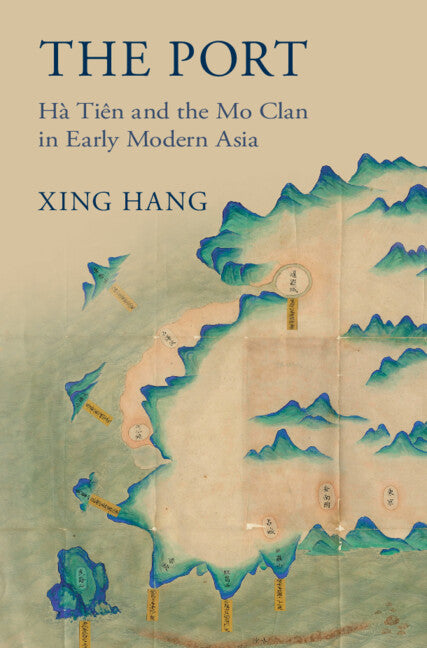
The Port
Hà Tiên and the Mo Clan in Early Modern Asia
The remarkable story of Hà Tiên and the Mo clan sheds new light on a transformative period in East Asian history.
Xing Hang (Author)
9781009426985, Cambridge University Press
Hardback, published 28 November 2024
374 pages
23.5 x 15.9 x 2.5 cm, 0.67 kg
'This study of Ha Tien (in modern Vietnam) shows how the Mo clan drew on the networks of trade, ethnicity, kinship, and Chinese culture to create a cosmopolitan hub that retained its own distinct identity. It is a major contribution to our understanding of the 'water world' in early modern Southeast Asia.'Barbara Watson Andaya Barbara Watson Andaya, University of Hawaiʻi at Mānoa
The Port (present-day Hà Tiên), situated in the Mekong River Delta and Gulf of Siam littoral, was founded and governed by the Chinese creole Mo clan during the eighteenth century and prospered as a free-trade emporium in maritime East Asia. Mo Jiu and his son, Mo Tianci, maintained an independent polity through ambiguous and simultaneous allegiances to the Cochinchinese regime of southern Vietnam, Cambodia, Siam, and the Dutch East India Company. A shared value system was forged among their multiethnic and multi-confessional residents via elite Chinese culture, facilitating closer business ties to Qing China. The story of this remarkable settlement sheds light on a transitional period in East Asian history, when the dominance of the Chinese state, merchants, and immigrants gave way to firmer state boundaries in mainland Southeast Asia and Western dominance on the seas.
Introduction
1. The port before 'the port'
2. Managing hybridity
3. Situating space through verse
4. Ambiguous associations
5. A port with many faces
6. The business of business
7. Clash of the titans
Conclusion
Glossary.
Subject Areas: Asian history [HBJF]