Freshly Printed - allow 10 days lead
Couldn't load pickup availability
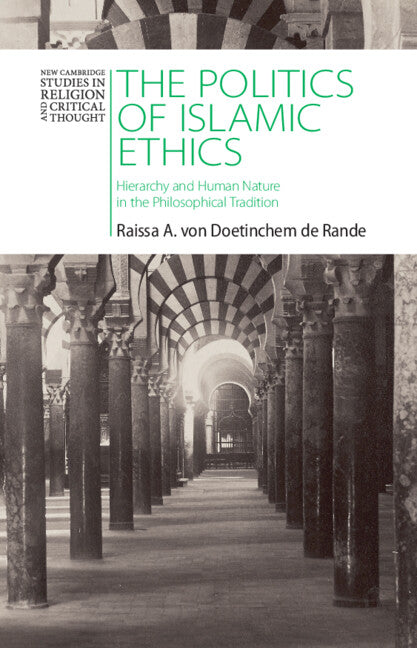
The Politics of Islamic Ethics
Hierarchy and Human Nature in the Philosophical Tradition
Explores an important but overlooked strand of classical Islamic philosophy to address wider contemporary and contested issues in Islamic ethics.
Raissa A. von Doetinchem de Rande (Author)
9781009566186, Cambridge University Press
Hardback, published 10 July 2025
348 pages
22.2 x 14.7 x 2.3 cm, 0.56 kg
'What is fiṭra? Is it a primordial disposition towards knowledge of God, or humans' inborn first intelligibles? Is it the same in all humans, or does it vary among them? What is its ethical content, and can individuals or society shape this? What does the concept of fiṭra contribute to discourses on religion, philosophy, political philosophy or society's normative socio-political order? Does fiṭra promote social hierarchy or equality? And why has the concept held the attention of so many important thinkers? In this probing and fascinating examination of the writings of the falāsifa al-Farābī, Ibn Bājja, Ibn Tuò fayl and Ibn Rushd the Grandson, as well as Muslim exegetes, Raissa von Doetinchem de Rande takes up these and countless other seminal questions. Her expansive and deeply penetrating treatment canvasses the various responses put forth and the tensions between them. Henceforth, no serious discussion of this topic will be able to dispense with this rich and insightful text.' Sherman A. Jackson, King Faisal Chair of Islamic Thought and Culture, The University of Southern California, author of The Islamic Secular (2024)
Fundamental to Islamic thought is the idea that there is a way that human beings simply are, by nature or creation. This concept is called fiṭra. Rooting her investigation in the two central passages in the Qur'an and Hadith literature, where it is asserted that God created human beings in a certain way, the author moves beyond discussion of the usual figures who have commented on those texts to look instead at a group of classical Islamic philosophers rarely discussed in conjunction with ethical matters. Tracing the development of fiṭra through this overlooked strand of medieval thinking, von Doetinchem de Rande uses fiṭra as an entrée to wider topics in Islamic ethics. She shows that the notion of fiṭra articulated by al-Farabi, Ibn Bajja, Ibn Tufayl and Ibn Rushd highlights important issues about organizational hierachies of human nature. This, she argues, has major implications for contemporary political and legal debates.
Introduction
1. Aristotelian logic and Platonic politics: fiṭra as the seat of human dispositions and source of the first intelligibles and its implications for the division of the city in al-Fārābī
2. The (mystical) individual and community: sociality, solitude, and the life of the exceptional philosopher in Ibn Bājja and Ibn Ṭufayl
3. Revealed law and egalitarianism: shifting emphases in the conception and use of Fiṭra in Ibn Rushd's thought
Conclusion.
Subject Areas: Islam [HRH]