Freshly Printed - allow 10 days lead
Couldn't load pickup availability
The Politics of Depression in France 1932–1936
This book examines debates about the formation of French economic policy during the Great Depression.
Julian Jackson (Author)
9780521522670, Cambridge University Press
Paperback, published 22 August 2002
316 pages
22.9 x 15.2 x 1.8 cm, 0.47 kg
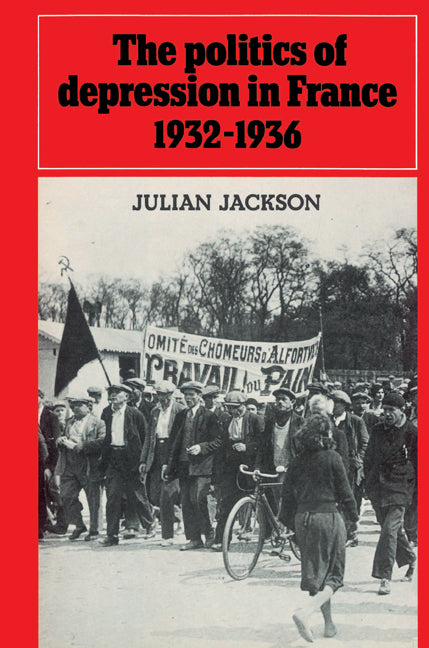
The poor performance of the French economy in the 1930s has long been recognised as a major contributory factor in the decline of the Third Republic, which collapsed after the defeat of 1940. Although France entered the Great Depression later than the rest of the world, French governments failed to learn from the experience of other countries in combating it. This book is the first full study of the formation of economic policy in these crucial years, and of the political debate to which it gave rise. It examines the origins of the notion of planning and the 'planomania', which gripped France in 1934; and it shows why this solution was ultimately rejected. It also analyses in detail the arguments of pro- and anti-devaluers. The conclusion suggests that stagnation was to some extent chosen as a conscious policy, since at least until 1936 the Depression never seemed severe enough to threaten the social order.
Acknowledgements
Abbreviations
Introduction
Part I. The Background: 1. The context
2. The inheritance
3. Programmes of the left
Part II. The Course of Policy: Government and Opposition 1932–1936
4. From le 8 Mai to le 6 Février: the misunderstanding
5. Varieties of deflation 1934–1936
6. The programme of the Popular Front
Part III. Non-Conformists of Left and Right: 7. Plans and planners
8. Devaluation
Epilogue
Conclusion
Appendix
Notes
Bibliography
Index.
Subject Areas: 20th century history: c 1900 to c 2000 [HBLW], European history [HBJD]