Special Order - allow 2+ weeks lead
Couldn't load pickup availability
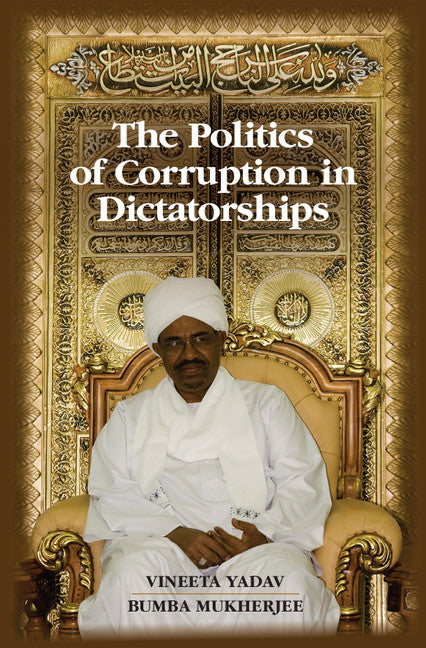
The Politics of Corruption in Dictatorships
This book analyzes why some dictators find it in their self-interest to curb corruption.
Vineeta Yadav (Author), Bumba Mukherjee (Author)
9781107083233, Cambridge University Press
Hardback, published 30 December 2015
334 pages, 32 b/w illus. 5 maps 20 tables
23.5 x 16.7 x 2.2 cm, 0.59 kg
'The authors challenge the widely accepted notion that dictatorships are synonymous with high levels of corruption, exploring why some autocratic regimes display high levels of corruption while others do not. Using case studies from Jordan, Malaysia and Uganda, they examine the political and economic factors that they believe disincentivise corruption.' Survival: Global Politics and Strategy
The Politics of Corruption in Dictatorships studies how institutional and social factors influence corruption in dictatorships. Dictatorships are often synonymous with high levels of corruption, yet Vineeta Yadav and Bumba Mukherjee argue otherwise. The authors ask why corruption has declined in some but not other authoritarian regimes. What are the main political factors that drive some autocrats to curb corruption? The book explores the role that business mobilization can play in reducing corruption under some conditions in dictatorships. It investigates how political competition for an elected legislature affects the incentives of dictators to engage in corruption. The study relies on case studies from Jordan, Malaysia, and Uganda. The book is accessible to a wide audience without requiring sophisticated statistical training.
1. Introduction
2. Geographic concentration and political mobilization by small and medium-sized business firms
3. SME business association, multiparty legislature, and corruption
4. Geographic concentration and national SME association in autocracies: the empirical evidence
5. Empirical analysis of legislative institutions, SME firms, and corruption in autocracies
6. Jordan: institutional change and corruption
7. Malaysia: SME mobilization, and corruption
8. Uganda: the contrarian case
9. Conclusion and implications.
Subject Areas: Comparative politics [JPB]