Special Order - allow 2+ weeks lead
Couldn't load pickup availability
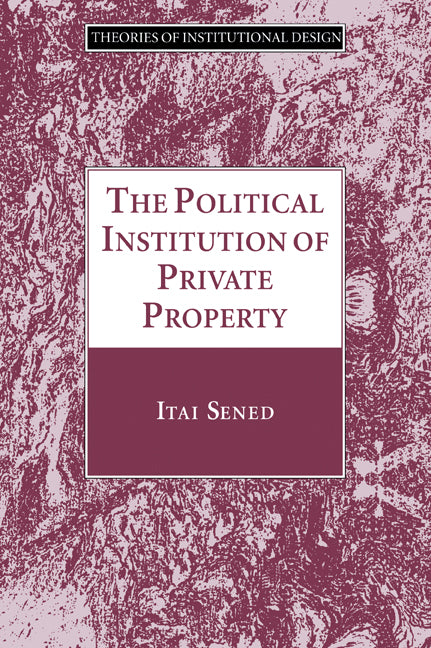
The Political Institution of Private Property
An original analysis of the political institutions which protect property and individual rights.
Itai Sened (Author)
9780521062879, Cambridge University Press
Paperback / softback, published 15 May 2008
220 pages, 1 b/w illus. 20 tables
22.8 x 15.2 x 1.7 cm, 0.34 kg
"This is a very timely work. Actors in the postcommunist world are creating, altering, and redistributing property rights on a scale rarely seen. Sened provides a very useful approach to study these cases. Moreover, these cases offer the opportunity to buil on Sened's impressive work." Timothy Frye, Political Science Quarterly
In this book, Itai Sened examines the political institution of property and other individual rights. His argument is that the foundation of such rights is to be found in the political and economic institutions which grant and enforce them and not in any set of moral principles or 'nature'. The book further argues that individual rights are instituted through a political process, and not by any hidden market forces. The origin of rights is placed in a social contract that evolves as a political process in which governments grant and protect property and other individual rights to constituents, in return for economic and political support. Extending neo-institutional theory to the subject, and using a positive game theoretic approach in its analysis, this book is an original contribution to scholarship on the evolution of rights.
List of figures and tables
Preface and acknowledgements
Introduction
1. Classical theories of the origin of rights: the social contract
2. Neo-classical theories of the origin of property rights: non-strategic individuals in a world without politics
3. A game theoretic approach: contemporary theory of institutions
4. A neo-liberal theory of the state: the role of government in the evolution of property rights
5. A neo-liberal theory of the social contract: the role of autonomous individuals in the evolution of property rights
6. Political entrepreneurs: the linkage between autonomous individuals and central agents
7. A case study: the grant of private property rights in air slots
Conclusion: the political origin of human rights
References
Index.
Subject Areas: Political economy [KCP]