Special Order - allow 2+ weeks lead
Couldn't load pickup availability
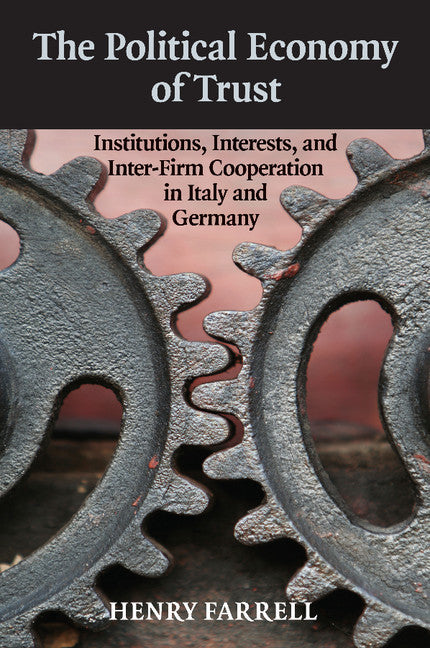
The Political Economy of Trust
Institutions, Interests, and Inter-Firm Cooperation in Italy and Germany
This book sets out a rationalist theory of how institutions - especially informal institutions - can affect trust without reducing it to fully determine expectations.
Henry Farrell (Author)
9781107404304, Cambridge University Press
Paperback / softback, published 10 May 2012
258 pages
22.9 x 15.2 x 1.5 cm, 0.38 kg
“Henry Farrell’s important book is a crucial contribution to the literature on social trust, and will be particularly influential among those seeking to understand the roots of coordinated market arrangements in advanced political economies. Boldly bridging the divide between rational-choice microfoundations and institutionalist macro-theorizing, while also bringing in culturalist perspectives, Farrell shows how trust can be grounded in informal institutions that were created for quite different reasons than the production or sustenance of cooperation. In doing so, he provides a powerful new way of understanding the role of trust in social, political, and economic life.”
-Jacob S. Hacker, Yale University
Trust and cooperation are at the heart of the two most important approaches to comparative politics - rational choice and political culture. Yet we know little about trust's relationship to political institutions. This book sets out a rationalist theory of how institutions - and in particular informal institutions - can affect trust without reducing it to fully determine expectations. It then shows how this theory can be applied to comparative political economy, and in particular to explaining inter-firm cooperation in industrial districts, geographical areas of intense small firm collaboration. The book compares trust and cooperation in two prominent districts in the literature, one in Emilia Romagna, Italy, and the other in Baden-Württemberg, Germany. It also sets out and applies a theory of how national informal institutions may change as a result of changes in global markets, and shows how similar mechanisms may explain persistent distrust too among Sicilian Mafiosi.
Acknowledgments
1. Introduction
2. A theory of institutions and trust
3. Varieties of capitalism and industrial districts
4. Trust and institutions in industrial districts
5. Accounting for change in informal institutions
6. Informal institutions without trust: relations among Mafiosi in Sicily
7. Conclusions
Bibliography
Index.
Subject Areas: Comparative politics [JPB], Political science & theory [JPA]