Freshly Printed - allow 10 days lead
Couldn't load pickup availability
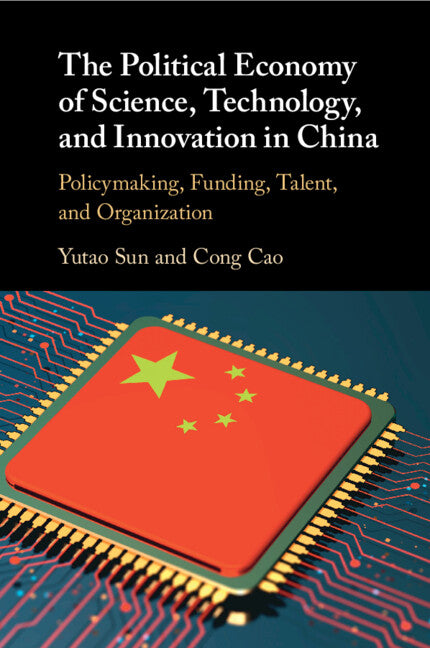
The Political Economy of Science, Technology, and Innovation in China
Policymaking, Funding, Talent, and Organization
Demystifies the role of the Chinese state in its development of S&T and innovation using the theory of political economy.
Yutao Sun (Author), Cong Cao (Author)
9781108796033, Cambridge University Press
Paperback / softback, published 8 August 2024
264 pages
22.9 x 15.2 x 1.4 cm, 0.387 kg
'This is a sensible and informative account of China's largely state-dominated science, technology, and innovation systems (STI). The practical and theoretical importance of the subject is encapsulated in one of the book's findings: China's capacity for innovation is not, by and large, cutting edge, but in most respects it appears sufficient to drive economic vitality. This feature of the Chinese case is at odds with the general consensus, which holds that only cutting-edge innovation in a developed country is sufficient to drive economic growth and prosperity. Yutao Sun's and Cong Cao's account provides a wealth of practical information to help explain this apparent contradiction.' Scott Moore, The China Journal
There are a variety of reasons underlying the remarkable development of science and technology (S&T), and innovation in post-1978 China. This book seeks to achieve an understanding of such development from an institutional or a political economy perspective. Departing from the literature of S&T and innovation studies that treats innovation as a market or enterprise's behavior in Schumpeter's sense, Sun and Cao argue that it involves politics, institutions, and the role of the state. In particular, they examine how the Chinese state has played its visible role in making innovation policies, allocating funding for R&D programs, making efforts to attract talent, and organizing critical S&T programs. This book appeals to scholars in S&T and innovation policy, political economy, innovation governance, and China studies as well as policymakers and business executives.
Introduction
1. Studying Science, Technology and Innovation: Bringing the State in
2. Innovation Policies: Institutional Structure and Evolution
3. Innovation Policies: Policy Network and Policymaking Process
4. Funding: Central Government Expenditure on Research and Development
5. Talent: Talent-Attracting Programs
6. Organization: Mission-Oriented Mega-Research-and-Development Programs
7. Toward a Political Economy of Science, Technology, and Innovation in China.
Subject Areas: Political economy [KCP]