Freshly Printed - allow 10 days lead
Couldn't load pickup availability
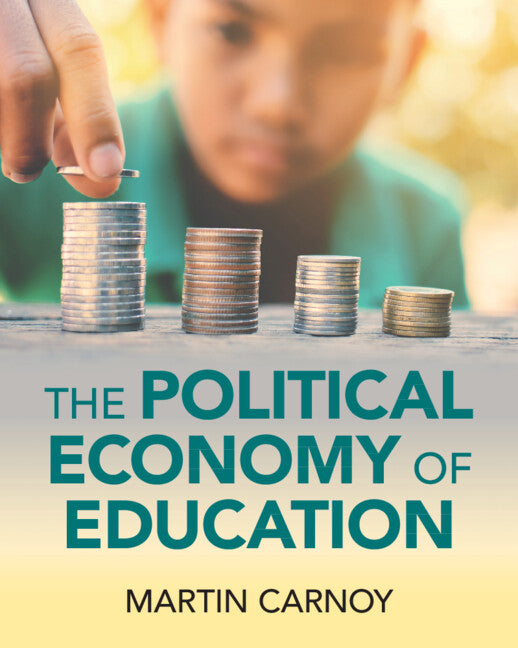
The Political Economy of Education
A textbook providing academically rigorous yet clear explanations of the economics and politics driving today's educational systems.
Martin Carnoy (Author)
9781009364447, Cambridge University Press
Paperback / softback, published 15 February 2024
564 pages
25.4 x 20 x 3 cm, 1.192 kg
'A huge undertaking! Martin's new book is great testament to the value of interdisciplinary work in helping us understand nuance. For those interested in better understanding the workings of educational systems around the world, or in trying to improve them, this book can help you succeed at both.' Guilherme Lichand, Stanford Graduate School of Education
The Political Economy of Education provides academically rigorous yet clear explanations of the economics and politics driving today's educational systems and how economists analyze them. The book covers a host of topics central to teaching about education and crucial to educational policy. These include how to use the tools of economic and political theory to take critical measure of education's role in social mobility and economic growth, whether good teachers can overcome social class and race achievement gaps, the effectiveness of early childhood and vocational education, and debates on school accountability and whether increasing spending on schooling improves quality. The book also explores worldwide changes in higher education, especially massification and increased stratification and privatization. Written for upper undergraduate and graduate students in economics, public policy, and education and packed with real-world examples, this is an essential text for anyone interested in gaining fresh and international perspectives on education.
Preface
Part I. Introduction: 1. The political economy of education
2. The contribution of the economics of education to education policy
3. The state and education
Part II. Human Capital: 4. Education, labor markets, and earnings
5. Age-earnings profiles and the returns to human capital
6. Measuring the returns to investment in education according to the human capital model
Part III. Alternatives to Human Capital: 7. Alternative conceptions of the relation between skill acquisition and productivity
8. Conditioned choice and discrimination
Part IV. Education, Economic Growth, and Income Distribution: 9. Education and economic growth
10. Education and income distribution
Part V. Educational Production Functions: 11. Underlying issues in educational production functions
12. Modeling and estimating educational production functions
13. Cost-effectiveness and cost-benefit analysis
14. Issues in early childhood education
15. Issues in the production of vocational education
Part VI. Teacher Labor Markets: 16. Fundamental elements in the study of teacher labor markets
17. The supply of and demand for teachers
18. Teacher salaries
19. The politics of teacher labor markets
Part VII. School System Accountability: 20. Public sector accountability
21. Market accountability
Part VIII. Financing Education: 22. Educational spending
23. Collecting and allocating revenue for education
24. More spending on education, improved student achievement, and other student outcomes
Part IX. The Political Economy of Higher Education: 25. Higher educational expansion as a global phenomenon
26. The financing of higher education
27. Higher education as an industry
28. Academic labor markets and student college choice strategies
References
Index.
Subject Areas: Public finance [KFFD]