Freshly Printed - allow 8 days lead
Couldn't load pickup availability
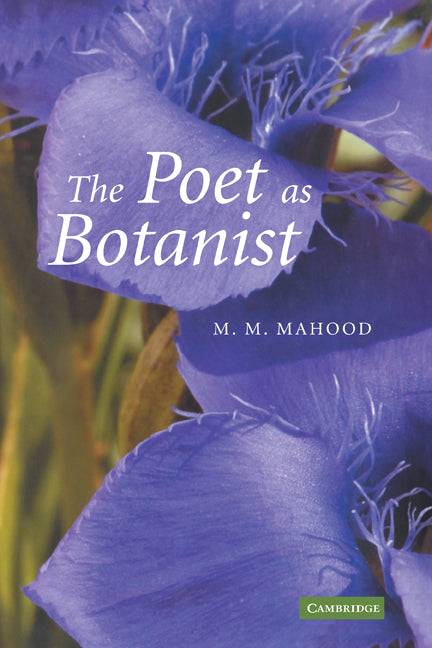
The Poet as Botanist
This book examines plants and botany in the writing of D. H. Lawrence and John Clare, among others.
M. M. Mahood (Author)
9780521188722, Cambridge University Press
Paperback, published 3 March 2011
282 pages
22.9 x 15.2 x 1.6 cm, 0.42 kg
'Mahood's writing is both inviting and engaging, and the chapters on Erasmus Darwin, Crabbe and Clare make particularly important contributions to the growing body of scholarship on these hitherto underexplored poets.' Annotated Bibliography of English Studies
For centuries, poets have been ensnared - as one of their number, Andrew Marvell put it - by the beauty of flowers. Then, from the middle of the eighteenth century onward, that enjoyment was enriched by a surge of popular interest in botany. Besides exploring the relationship between poetic and scientific responses to the green world within the context of humanity's changing concepts of its own place in the ecosphere, Molly Mahood considers the part that flowering plants played in the daily lives and therefore in the literary work of a number of writers who could all be called poet-botanists: Erasmus Darwin, George Crabbe, John Clare, John Ruskin and D. H. Lawrence. A concluding chapter looks closely at the meanings, old or new, that plants retained or obtained in the violent twentieth century.
Introduction
1. Primroses at Dove Cottage and Down House
2. Erasmus Darwin's feeling for the organism
3. Crabbe's Slimy Mallows and Suffocated Clover
4. John Clare: bard of the wild flowers
5. Ruskin's flowers of evil
6. D. H. Lawrence, botanist
7. Poetry and photosynthesis.
Subject Areas: Botany & plant sciences [PST], Literary studies: poetry & poets [DSC]