Freshly Printed - allow 10 days lead
Couldn't load pickup availability
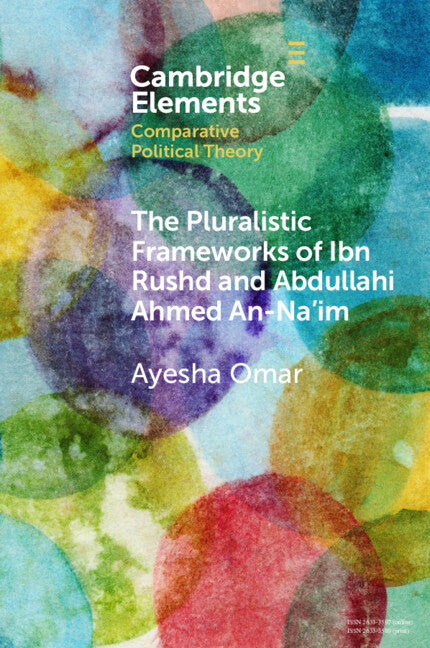
The Pluralistic Frameworks of Ibn Rushd and Abdullahi Ahmed An-Na'im
What do the pluralistic frameworks of the Islamic political thinkers Ibn Rushd and Abdullahi An-Na'im tell us about ethics and politics in Islam?
Ayesha Omar (Author)
9781009386326, Cambridge University Press
Paperback / softback, published 20 February 2025
86 pages
22.8 x 15.1 x 0.5 cm, 0.14 kg
The purpose of this Element is to analyse the assiduous attempts of two Islamic political thinkers-the 12th century Andalusian philosopher Ibn Rushd and the contemporary Sudanese reformist Abdullahi Ahmed An-Na'im-to theorise Islamic politics through an approach the author refers to as 'pluralistic frameworks'. A pluralistic framework, is a systematic mediation of Islamic ethics and politics that incorporates extra-Islamic traditions of thought from diverse sources. Pluralistic frameworks selectively and self-consciously enable dialogue, synthesis, and hybridity and seek to maintain a distinct conception of Islamic ethics that concords with a preferred set of political arguments. They enable reflexivity within the ethical purview of Islam and with an awareness of the normativity of sharī'a.Both Ibn Rushd and An-Na'im reconcile sharī'a in two very different ways, but to a common end; Ibn Rushd lays out a method of harmonisation with Greek thought, while An-Na'im resorts to the radical subversion of sharia under liberal thought.
1. Islamic Ethics and Politics
2. Harmonising Greek Thought and sharī'a: The Pluralistic Framework of Ibn Rushd
3. Negotiating sharī'a and Liberal Thought: The Pluralistic Framework of Abdullahi Ahmed An-Na'im
4. Rethinking Islamic Politics: Pluralistic Frameworks and the Future
Bibliography.
Subject Areas: Political science & theory [JPA]