Freshly Printed - allow 10 days lead
Couldn't load pickup availability
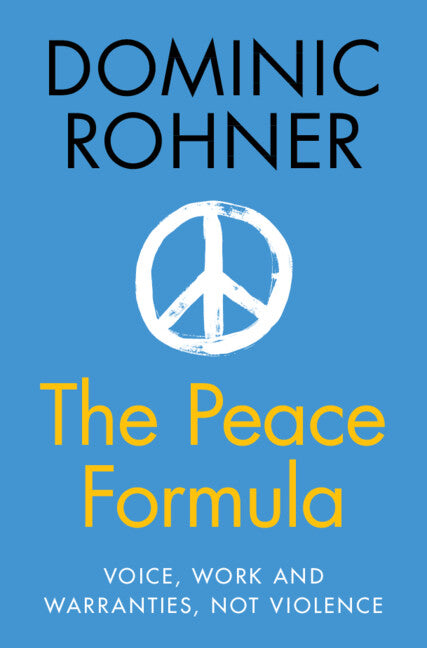
The Peace Formula
Voice, Work and Warranties, Not Violence
Based on decades of academic evidence, the book develops the 'peace formula' and explains how 'smart idealism' gets us there.
Dominic Rohner (Author)
9781009438315, Cambridge University Press
Hardback, published 15 August 2024
248 pages
23.5 x 16 x 1.9 cm, 0.5 kg
'a brave academic voice of hope.' Paul Collier, A TLS Book of the Year
Economic forces play a major role in the outbreak and perpetuation of violence, but they also hold the key for positive change. Using a non-technical and accessible style, The Peace Formula attacks a series of misconceptions about how economics has been used to foster peace. In place of these misconceptions, this book draws on rich historical anecdotes and cutting-edge academic evidence to outline the 'peace formula' – a set of key policies that are crucial ingredients for curbing armed conflict and achieving transition to lasting peace and prosperity. These policies include providing jobs (work), democratic participation (voice), and guaranteeing the security and basic functions of the state (warranties). Investigating specific political institutions and economic policies, this book provides the first easily accessible synthesis of this work and explains how 'smart idealism' can help us get the incentives of our leaders right. The stakes could hardly be higher.
Acknowledgements
Part I. Apocalypse No! Why We Should Care: 1. Smart Idealism and the Peace Formula: Introduction
2. Loss of Lives, Livelihoods and Love: Wars Are Not Good Business
3. Vicious Cycles of Conflict – Why Wars Today Threaten Our Future
Part II. The Logic of Evil: Why Wars Occur: 4. Poverty, Populations and Petrol: Why Do People Fight?
5. The Killer in the Boardroom: How Fighting in Funded
Part III. Give Peace a Chance! Getting Incentives Right: 6. Power to the People: Inclusive Democracy and Power-Sharing
7. State Capacity for Stability
8. Plenty Makes Peace: Education, Health and Labor Market Policies
9. Forgiving not Fighting: Fostering Trust and Reconciliation
10. A Role For All Of Us? Smart Idealism, Global Public Opinion and International Support for Peace
11. Global Coordination to Curb Conflict
Part IV. The Art of Peace: Take Home Messages: 12. Conclusion
References
Index.
Subject Areas: Microeconomics [KCC]