Freshly Printed - allow 10 days lead
Couldn't load pickup availability
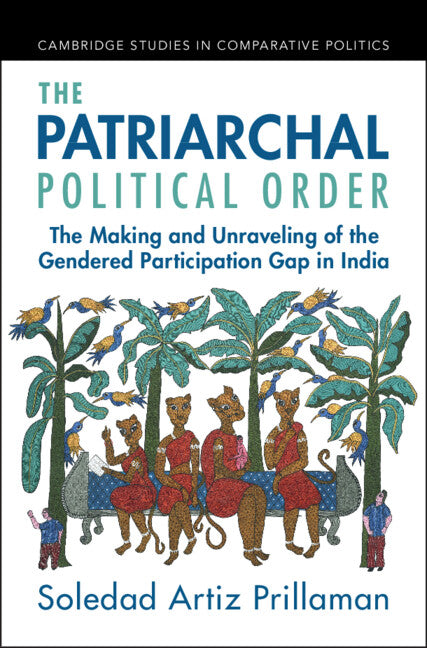
The Patriarchal Political Order
The Making and Unraveling of the Gendered Participation Gap in India
Exposes how coercive political power structures diminish political participation for women in India and chronicles women's pathways to power.
Soledad Artiz Prillaman (Author)
9781009355759, Cambridge University Press
Hardback, published 14 December 2023
384 pages
23.5 x 15.5 x 2.6 cm, 0.69 kg
'Soledad Prillaman explores a surprising outcome: programs designed to bring women together to increase credit have the additional benefit of increasing women's networks and political participation substantially, arguably with greater ground-level effects than for some more targeted inclusion programs. She expertly shows how and why this matters, for women in India, and for more inclusive political and development outcomes around the world.' Steven Wilkinson, Nilekani Professor of India and South Asian Studies, Professor of Political Science and International Affairs, Yale University
Women across the Global South, and particularly in India, turn out to vote on election days but are noticeably absent from politics year-round. Why? In The Patriarchal Political Order, Soledad Artiz Prillaman combines descriptive and causal analysis of qualitative and quantitative data from more than 9,000 women and men in India to expose how coercive power structures diminish political participation for women. Prillaman unpacks how dominant men, imbued with authority from patriarchal institutions and norms, benefit from institutionalizing the household as a unitary political actor. Women vote because it serves the interests of men but stay out of politics more generally because it threatens male authority. Yet, when women come together collectively to demand access to political spaces, they become a formidable foe to the patriarchal political order. Eye-opening and inspiring, this book serves to deepen our understanding of what it means to create an inclusive democracy for all.
Part I. The Puzzle of Women's Political Participation: 1. Introduction
2. Patriarchy, inequality, and the political lives of rural Indian women
3. A relational theory of women's political participation
Part II. The Patriarchal Political Order: 4. The patriarchal political household
5. Political behavior under household cooperation
6. The patriarchal political order – networks and the nature of political organization
Part III. The Unravelling
7. The power of autonomy from the household and women's collective action
8. Consciousness-raising as the ignition for collective action
Part IV. Consequences of Inclusion: 9. Women's mobilization across India and its portents
10. Conclusion: political inclusion as a path to social change.
Subject Areas: Comparative politics [JPB]