Freshly Printed - allow 8 days lead
Couldn't load pickup availability
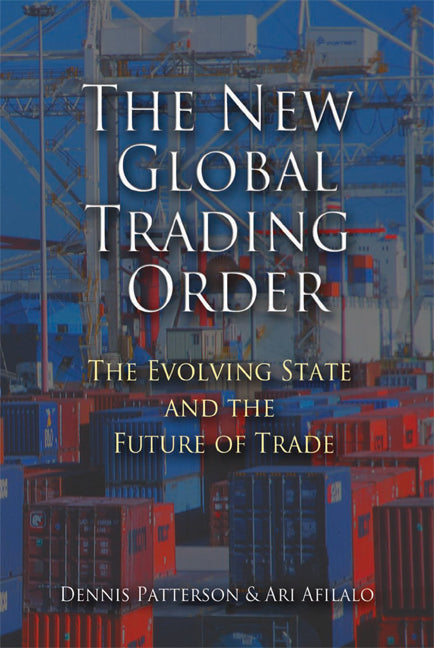
The New Global Trading Order
The Evolving State and the Future of Trade
This book proposes concrete norms and institutions to overhaul the global trading order for the 21st century.
Dennis Patterson (Author), Ari Afilalo (Author)
9780521875189, Cambridge University Press
Hardback, published 31 March 2008
288 pages
23.5 x 15.8 x 2 cm, 0.52 kg
'The New Global Trading Order is a thought-provoking work, which made an early contribution to an emerging body of literature seeking to shed a humanist view on the world trading system.' Sonia E. Rolland, Jurisprudence
The international institutions that have governed global trade since the end of World War II have lost their effectiveness, and global trade governance is fractured. The need for new institutions is obvious, and yet, few proposals seem to be on offer. The key to understanding the global trading order lies in uncovering the relationship between trade and the State, and how the inner constitution of Statecraft drives the architecture of the global order and requires structural changes as the State traverses successive cycles. The current trade order, focused on the liberalization of trade in goods and services and the management of related issues, is predicated on policies and practices that were the product of a global trading order of the 20th-century modern nation-states. Today, a new form of the State - the post-modern State - is evolving. In this book, the authors propose a new trade norm - the enablement of global economic opportunity - and a new institution - the Trade Council - to overhaul the global trading order.
1. Introduction
2. The evolving state
3. The changing nature of welfare
4. Disaster and redemption: 1930s and Bretton Woods
5. The transformation of the Bretton Woods world and the rise of a new economic order
6. The end of Bretton Woods and the beginning of a new global trading order
7. The enablement of global economic opportunity
8. Trade and security
Conclusion.
Subject Areas: International economic & trade law [LBBM], International trade [KCLT]