Freshly Printed - allow 6 days lead
Couldn't load pickup availability
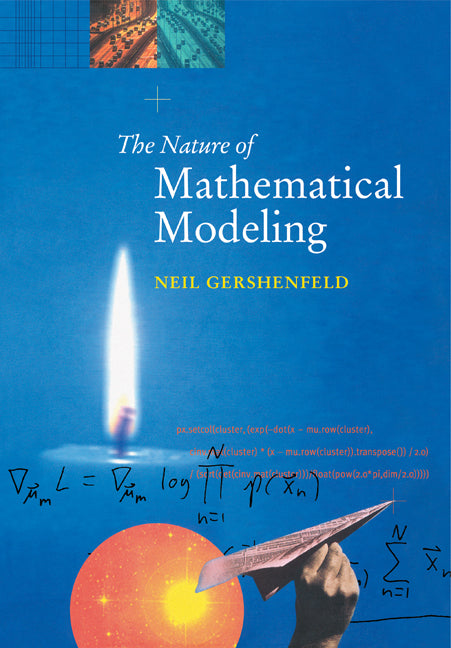
The Nature of Mathematical Modeling
Major text/reference work on computer modeling for students and researchers in any quantitative or semi-quantitative discipline, first published in 1998.
Neil Gershenfeld (Author)
9780521210508, Cambridge University Press
Paperback, published 23 June 2011
358 pages
24.4 x 17 x 1.9 cm, 0.57 kg
Review of the hardback: 'The book offers a useful; insight into modelling with mathematical modelling and computer implematation its main concern. The author achieves his aim; of producing a well-written account of the simple and efficient ways in which such models can be implemented.' Kybernetes
This 1998 book, about the nature and techniques of mathematical modeling, is oriented towards simple efficient implementations on computers. The text is in three sections. The first covers exact and approximate analytical techniques; the second, numerical methods; the third, model inference based on observations; and the last, the special role of time in modeling. Each of the topics in the book would be the worthy subject of a dedicated text, but only by presenting the material in this way is it possible to make so much material accessible to so many people. Each chapter presents a concise summary of the core results in an area, providing an orientation to what they can (and cannot) do, enough background to use them to solve typical problems, and pointers to access the literature for particular applications. The text is complemented by extensive worked problems.
Preface
1. Introduction
Part I. Analytical Models: 2. Ordinary differential and difference equations
3. Partial differential equations
4. Variational principles
5. Random systems
Part II. Numerical Models: 6. Finite differences: ordinary difference equations
7. Finite differences: partial differential equations
8. Finite elements
9. Cellular automata and lattice gases
Part III. Observational Models: 10. Function fitting
11. Transforms
12. Architectures
13. Optimization and search
14. Clustering and density estimation
15. Filtering and state estimation
16. Linear and nonlinear time series
Appendix 1. Graphical and mathematical software
Appendix 2. Network programming
Appendix 3. Benchmarking
Appendix 4. Problem solutions
Bibliography.
Subject Areas: Physics [PH]