Freshly Printed - allow 10 days lead
Couldn't load pickup availability
The Moon
Considered as a Planet, a World, and a Satellite
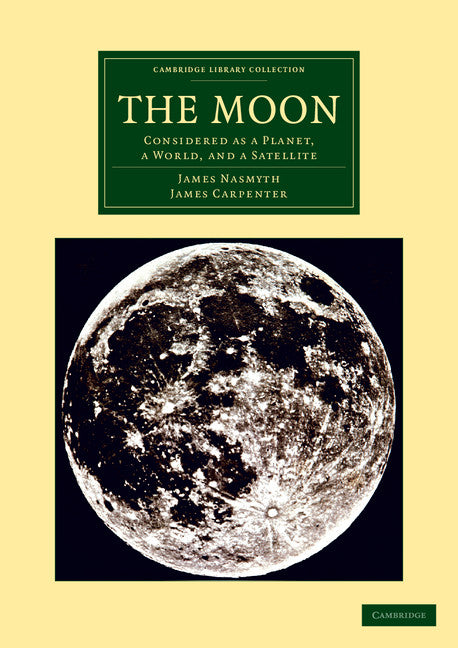
First published in 1874, this monograph is notably illustrated with photographs of accurate plaster models of the lunar surface.
James Nasmyth (Author), James Carpenter (Author)
9781108065306, Cambridge University Press
Paperback / softback, published 5 September 2013
256 pages, 69 b/w illus. 1 colour illus.
29.7 x 21 x 1.4 cm, 0.62 kg
The movement of the moon in space had been well documented by the second half of the nineteenth century. In this monograph, which first appeared in 1874, James Nasmyth (1808–90) and James Carpenter (1840–99) pay closer attention to the lunar surface, notably illustrating their work with photographs of accurate plaster models. At this time, many questions about the moon's properties were still open. Could the moon support life? Did it have an atmosphere? How had its craters been formed? Marshalling the latest available evidence, Nasmyth and Carpenter provide their answers in a text accompanied by explanatory diagrams. Also included are theories on planetary formation, a discussion of lunar volcanism, and a vivid imagining of a day on the moon's surface, describing everything from low lunar gravity to the sudden, monthly sunrise. The work remains an instructive resource, reflecting the state of contemporary astronomical knowledge.
Preface
1. On the cosmical origin of the planets of the solar system
2. The generation of cosmical heat
3. The subsequent cooling of the igneous body
4. The form, magnitude, weight, and density of the lunar globe
5. On the existence or non-existence of a lunar atmosphere
6. The general aspect of the lunar surface
7. Topography of the moon
8. On lunar craters
9. On the great ring-formations not manifestly volcanic
10. Peaks and mountain ranges
11. Cracks and radiating streaks
12. Colour and brightness of lunar details: chronology of formations, and finality of existing features
13. The moon as a world: day and night upon its surface
14. The moon as a satellite: its relation to the earth and man
15 Concluding summary.
Subject Areas: Astronomy, space & time [PG]