Freshly Printed - allow 5 days lead
Couldn't load pickup availability
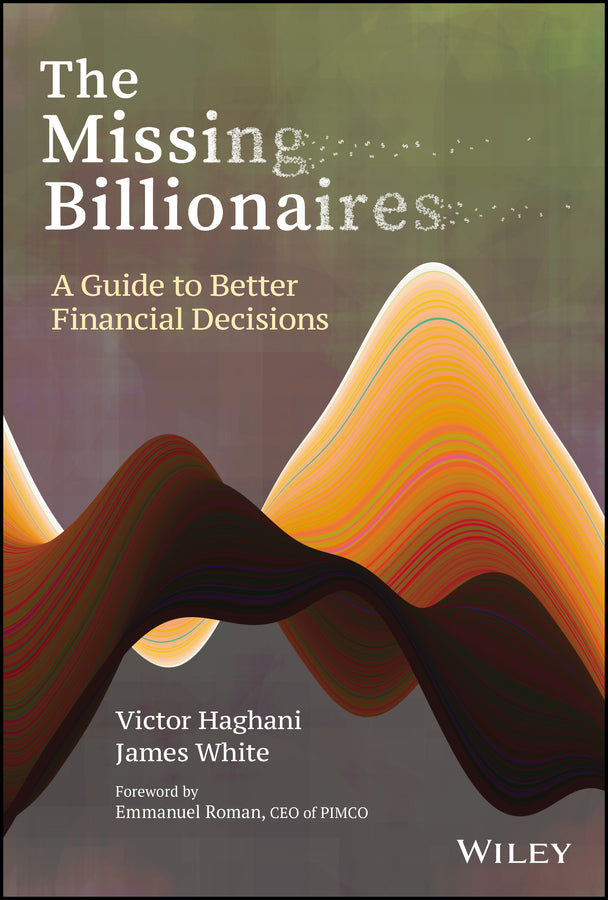
The Missing Billionaires
A Guide to Better Financial Decisions
"This is a marvelous book that importantly extends the literature on financial decision-making. The authors creatively weave together the essence of practical considerations with insightful academic theory. One of a small handful of books that is timeless and should be read and reread over a lifetime for enjoyment and substance." "The missing billionaires in the book's title allude to the difficulty of keeping already-made fortunes. Believing that nobody should get rich twice, Victor and James arm investors with lessons galore, drawn from their long practitioner careers. Yet the core lessons come from academia, and this wonderful book gives the best shot for Expected Utility and lifecycle models to finally become widely used in real-world investment decision-making. Uniquely, this book puts position sizing in the center, showing through many illustrations how 'too much of a good thing' can be just too much." "The Missing Billionaires addresses a topic that gets far too little attention in the investment community: how much to invest. The book is a terrific blend of theory, practice, and stories from the front lines. This is must-reading for anyone seeking to invest and spend wisely." "I enjoyed and learned from Victor and James' book on incorporating uncertainty directly into making better financial decisions. Rightly so, for them, risk is front and center. This book is a great education for all of us, seamlessly marrying sophisticated theory with applications, demonstrating the beauty of a risk architecture that combines specificity with illuminating implementations into the lifetime wealth management problem."
—Gary P. Brinson, CFA, Author, and Founder of Brinson Partners
—Antti Ilmanen, Principal at AQR Capital, Author of Expected Returns
—Michael Mauboussin, Author and Head of Consilient Research, Morgan Stanley
—Myron S. Scholes, Frank E. Buck Professor of Finance, Emeritus, Stanford Graduate School of Business, Nobel Laureate in Economic Sciences
Victor Haghani (Author), James White (Author), Emmanuel Roman (Foreword by)
9781119747918, Wiley
Hardback, published 6 September 2023
416 pages
23.4 x 15.8 x 3.6 cm, 0.748 kg
"...a smart and sophisticated primer on quantitative risk-management techniques."
—The Wall Street Journal
"A compelling book dealing with an important and neglected question in finance: not what to buy or sell, but how much. Even sophisticated professionals tend to answer this question badly, leading to lost fortunes. But financial theory provides the answer. Mathematical but not excessively so, this will appeal to anyone with an interest in markets."
—The Economist Best Books of 2023, December 9-15, 2023
"The most important investment decision is not 'what' but 'how much.' If you ever hear a professional investor talk about a trade that taught them a lot, prick up your ears. Usually, this is code for 'a time I lost an absolutely colossal amount of money,' and you are in for one of the better stories about how finance works at the coalface. On this front, Victor Haghani is a man to whom it is worth listening. Now, along with his present-day colleague James White, he has written a book that aims to spare other investors his mistakes . . . The Missing Billionaires . . . examines what its authors argue is a much more important—and neglected—question than picking the right investments to buy or sell: not 'what' but 'how much.'"
—The Economist Buttonwood column "Size Matters," September 21, 2023
An Economist Best Book of the Year "Making Money and Keeping It" – The Wall Street Journal Over the past century, if the wealthiest families had spent a reasonable fraction of their wealth, paid taxes, invested in the stock market, and passed their wealth down to the next generation, there would be tens of thousands of billionaire heirs to generations-old fortunes today. The puzzle of The Missing Billionaires is why you cannot find one such billionaire on any current rich list. There are a number of explanations, but this book is focused on one mistake which is of profound importance to all investors: poor risk decisions, both in investing and spending. Many of these families didn’t choose bad investments– they sized them incorrectly– and allowed their spending decisions to amplify this mistake. The Missing Billionaires book offers a simple yet powerful framework for making important lifetime financial decisions in a systematic and rational way. It's for readers with a baseline level of financial literacy, but doesn’t require a PhD. It fills the gap between personal finance books and the academic literature, bringing the valuable insights of academic finance to non-specialists. Part One builds the theory of optimal investment sizing from first principles, starting with betting on biased coins. Part Two covers lifetime financial decision-making, with emphasis on the integration of investment, saving and spending decisions. Part Three covers practical implementation details, including how to calibrate your personal level of risk-aversion, and how to estimate the expected return and risk on a broad spectrum of investments. The book is packed with case studies and anecdotes, including one about Victor’s investment with LTCM as a partner, and a bonus chapter on Liar’s Poker. The authors draw extensively on their own experiences as principals of Elm Wealth, a multi-billion-dollar wealth management practice, and prior to that on their years as arbitrage traders– Victor at Salomon Brothers and LTCM, and James at Nationsbank/CRT and Citadel. Whether you are young and building wealth, an entrepreneur invested heavily in your own business, or at a stage where your primary focus is investing and spending, The Missing Billionaires: A Guide to Better Financial Decisions is your must-have resource for thoughtful financial decision-making.
Foreword xiii Preface xvii About the Authorsxxi Acknowledgments xxiii Chapter 1: Introduction: The Puzzle of the Missing Billionaires 1 Section I: Investment Sizing 13 Chapter 2: Befuddled Betting on a Biased Coin 15 Chapter 3: Size Matters When It’s for Real 27 Chapter 4: A Taste of the Merton Share 41 Chapter 5: How Much to Invest in the Stock Market? 49 Chapter 6: The Mechanics of Choice 67 Chapter 7: Criticisms of Expected Utility Decision-making 103 Chapter 8: Reminiscences of a Hedge Fund Operator 117 Section II: Lifetime Spending and Investing 127 Chapter 9: Spending and Investing in Retirement 129 Chapter 11: Spending Like You Won’t Live Forever 165 Section III: Where the Rubber Meets The Road 173 Chapter 12: Measuring the Fabric of Felicity 175 Chapter 13: Human Capital 193 Chapter 14: Into the Weeds: Characteristics of Major Asset Classes 201 Chapter 15: No Place to Hide: Investing in a World with No Safe Asset 235 Chapter 16: What About Options? 245 Chapter 17: Tax Matters 265 Chapter 18: Risk Versus Uncertainty 275 Section IV: Puzzles 285 Chapter 19: How Can a Great Lottery Be a Bad Bet? 287 Chapter 20: The Equity Risk Premium Puzzle 291 Chapter 21: The Perpetuity Paradox and Negative Interest Rates 297 Chapter 22: When Less Is More 303 Chapter 23: The Costanza Trade 309 Chapter 24: Conclusion: U and Your Wealth 319 Bonus Chapter: Liar’s Poker and Learning to Bet Smart 327 Cheat Sheet 335 A Few Rules of Thumb 340 Endnotes 343 Suggested Reading 357 References 359 Index 373
Subject Areas: Finance & accounting [KF]