Freshly Printed - allow 7 days lead
Couldn't load pickup availability
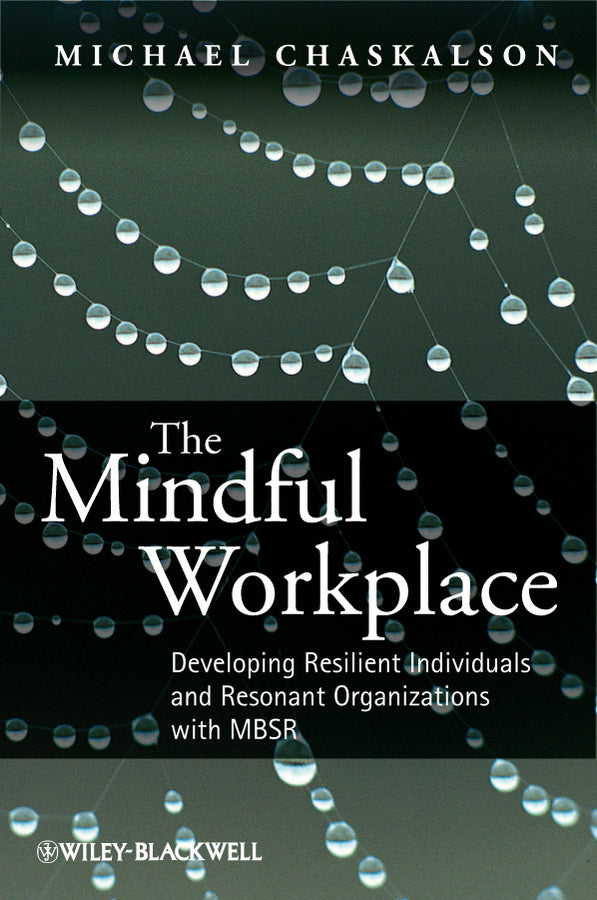
The Mindful Workplace
Developing Resilient Individuals and Resonant Organizations with MBSR
The forces of dissonance are all around us. They gnaw at us and eventually turn us into a person we neither recognize nor want to be. One of the few research proven antidotes to these ravages of chronic stress, over commitment, and being too busy, is working on our mindfulness. Michael Chaskalson provides a marvelous and engaging introduction to the arena and with practical steps for you and your organization. Don’t worry, you will not start to levitate after reading this book, but if you heed his message and practical steps, you will be healthier, experience heightened cognitive performance, and be more open to possibilities. In this important book, Michael Chaskalson presents a powerful case for the intentional enhancement of mindfulness in the workplace. He offers a clear and authoritative description of mindfulness and the ways in which we can facilitate it. Crucially, he also explains in detail why mindfulness training can have profoundly beneficial effects on a surprisingly wide range of aspects of individual and organizational function. In doing so, he draws on a wide base of research evidence, and on his own unique personal experience of decades of teaching awareness skills and of founding and running successful organizations. The Mindful Workplace deserves to be highly influential. This book is extraordinary. It offers a revolutionary and compelling solution to the problems faced in the 21st century workplace. Michael Chaskalson writes with superb clarity and wisdom to show that we no longer have to choose between economic imperatives and human well-being. Through training in mindfulness, both can flourish, to the benefit of all. A book that will be on the syllabus of every Business School that wishes to be on the frontier of knowledge and skills, but also a read for anyone who wants to understand why work can be so stressful and what to do about it.
—Richard Boyatzis, Distinguished University Professor, Case Western Reserve, co-author of ‘Primal Leadership’ and ‘Resonant Leadership’
—John Teasdale, co-author of ‘The Mindful Way through Depression’ and ‘Mindfulness-based Cognitive Therapy for Depression’
—Mark Williams, Director, Oxford Mindfulness Centre, and Co-author of ‘Mindfulness: a practical guide to finding peace in a frantic world’
Michael Chaskalson (Author)
9780470661598, Wiley
Paperback / softback, published 19 August 2011
232 pages
22.9 x 15.3 x 1.3 cm, 0.304 kg
"However, the general mindfulness applicability to therapy is highly welcomed and well written." (British Journal of Mental Health and Nursing, 1 July 2012) ". . . Simple exercises at the end of each chapter and numerous workplace examples make this it a fascinating, highly relevant read for any employee." (The Psychologist, 1 May 2012) "His book is a skilful weaving together of art, science and practice, presented with clarity, simplicity and warmth." (Mindful, 11 October 2011)
This book offers a practical and theoretical guide to the benefits of Mindfulness-Based Stress Reduction (MBSR) in the workplace, describing the latest neuroscience research into the effects of mindfulness training and detailing an eight-week mindfulness training course.
Foreword ix Preface xiii Introduction: The Business Case for Mindfulness Training 1 1 What Is Mindfulness? 13 2 What Is Mindfulness Practice? 31 3 Positive and Negative Stress: Up and Down the Yerkes–Dodson Curve 57 4 Approach and Avoidance: Learning New Ways to Be with What Is 73 5 Metacognition: Knowing Your Thoughts as Thoughts 89 6 Respond: Learning Not to React 101 7 Mindfulness and Emotional Intelligence: Positive Relationships at Work 111 8 Mindfulness for Leaders 127 9 Mindfulness in Coaching 145 10 Living Mindfully 157 11 Putting on an Eight-Week Mindfulness Course in a Workplace Setting 163 Appendix 1: Good Practice Guidance for Teaching Mindfulness-Based Courses 183 Appendix 2: Review of Significant Mindfulness Research 187 Appendix 3: Further Reading 191 Appendix 4: Further Training and Other Resources 193 Index 195
Subject Areas: Psychology [JM]