Special Order - allow 2+ weeks lead
Couldn't load pickup availability
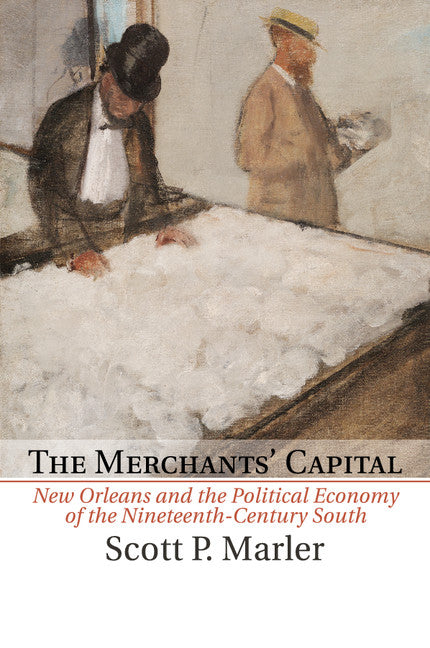
The Merchants' Capital
New Orleans and the Political Economy of the Nineteenth-Century South
This study examines the crucial role of merchants in the rise and decline of New Orleans during the nineteenth century.
Scott P. Marler (Author)
9781107557543, Cambridge University Press
Paperback / softback, published 8 October 2015
334 pages, 7 b/w illus. 14 tables
22.9 x 15.2 x 1.9 cm, 0.49 kg
'Prodigiously researched and elegantly argued, The Merchants' Capital deserves a wide readership.' Richard Follett, The Journal of Southern History
As cotton production shifted toward the southwestern states during the first half of the nineteenth century, New Orleans became increasingly important to the South's plantation economy. Handling the city's wide-ranging commerce was a globally oriented business community that represented a qualitatively unique form of wealth accumulation - merchant capital - that was based on the extraction of profit from exchange processes. However, like the slave-based mode of production with which they were allied, New Orleans merchants faced growing pressures during the antebellum era. Their complacent failure to improve the port's infrastructure or invest in manufacturing left them vulnerable to competition from the fast-developing industrial economy of the North, weaknesses that were fatally exposed during the Civil War and Reconstruction. Changes to regional and national economic structures after the Union victory prevented New Orleans from recovering its commercial dominance, and the former first-rank American city quickly devolved into a notorious site of political corruption and endemic poverty.
Introduction: merchants of the cotton South in the age of capital
Part I. The Antebellum Era: 1. Merchants and bankers in the 'great emporium of the South'
2. New Orleans merchants and the failure of industrial development
3. Rural merchants on the cotton frontier of antebellum Louisiana
Part II. The Civil War: 4. From secession to the fall of New Orleans, 1860–2
5. Bankers and merchants in occupied Louisiana - the Butler regime
Part III. Reconstruction: 6. New Orleans merchants and the political economy of reconstruction
7. The economic decline of postbellum New Orleans
8. Rural merchants and the reconstruction of Louisiana agriculture
9. Epilogue: merchant capital and economic development in the postbellum South.
Subject Areas: Economic history [KCZ], Modern history to 20th century: c 1700 to c 1900 [HBLL], History of the Americas [HBJK]